

 Vercel secured $250 million in funding and reached a $3.25 billion valuation in May 2024. The company’s growth stands out with its previous $102 million Series C funding round in June 2021. The valuation represents remarkable progress in just three years. Guillermo Rauch founded Vercel Inc as ZEIT in 2015, and the company has revolutionized the development platform space since then.
Enterprise adoption drives Vercel’s swift rise to prominence. The platform’s features have attracted an impressive roster of major clients. Under Rauch’s leadership, Vercel has built strategic collaborations with industry leaders and global brands. Their client list includes Airbnb, Uber, GitHub, Nike, Ticketmaster, Carhartt, IBM, and McDonald’s. This technical analysis examines Vercel’s path to its multi-billion dollar valuation. The company’s innovative deployment infrastructure, developer experience, and strategic acquisitions have established it as a leader in modern web development.
Founding Vision and Strategic Evolution of Vercel Inc

Image Source: www.gv.com
Vercel Inc started in 2015 as ZEIT when Guillermo Rauch grew frustrated with deploying modern web applications [1]. He created the company to connect advanced open-source technologies with intuitive user experiences that teams could deploy faster [2]. Their first product “Now” made deployment simple for developers who didn’t need complex infrastructure setup [3].
From ZEIT to Vercel: Rebranding and Market Positioning
Vercel, previously known as ZEIT, kept its triangular logo during its strategic rebrand in April 2020 [1][4]. This change happened alongside a $21 million Series A funding round [5]. The name “Vercel” connects to words like versatile, accelerate, and excel. These words reflect the platform’s core benefits that help teams build and collaborate better [5][6]. The company refined its focus to deliver “the ultimate workflow for developing, previewing, and shipping Jamstack sites” during this crucial phase [5].
Vercel CEO Guillermo Rauch’s Role in Developer-Centric Innovation
Rauch shaped Vercel’s direction through his deep open-source development experience. His achievements before Vercel include:
-
Creating Socket.IO in 2010, a popular library for real-time communication [7][8]
-
Working with MooTools as part of their core team [7]
-
Building Mongoose, now the most popular tool for MongoDB data access in JavaScript [7]
-
Co-creating Next.js, which became Vercel’s platform foundation [7]
His passion for developer experience, performance, and design became core principles in Vercel’s DNA [2]. The company grew beyond infrastructure automation to create groundbreaking AI-powered development tools under his guidance.
Key Milestones: Next.js, Socket.IO, and Open Source Contributions
Next.js represents Vercel’s biggest open-source achievement, now powering over 35,000 sites at companies like Uber, Nike, and Starbucks [5][6]. The framework makes development easier through its file system-based routing while supporting advanced patterns [1].
Vercel shows steadfast dedication to open source. Their website states: “Open source software is a major part of how we build our products. We believe in creating and maintaining valuable, free, and easy-to-use software for the community” [9]. This approach has drawn more than 300,000 frontend engineers and designers [5], making Vercel a leader in developer-focused breakthroughs.
Product Innovation Driving Valuation Growth

Image Source: TechCrunch
Vercel Inc’s dramatic valuation has grown through several groundbreaking product breakthroughs. These technical advances make the company a leading provider of developer tooling and enterprise solutions.
Launch of v0: Natural Language to Web App Generator
Vercel’s valuation surge comes from v0, its revolutionary text-to-app API that turns natural language descriptions into functioning web applications. The v0 Platform API gives developers a composable interface to automate web app building, integrate code generation into existing features, and create new products on top of LLM-generated UIs [10]. This complete solution creates both UI and backend logic instead of just mockups [11]. Companies employ v0 to build prototypes faster, test concepts with users, and transform mockups into high-fidelity interfaces that match real user flows [11].
AI SDK for Conversational Interfaces in JavaScript/TypeScript
Vercel’s market value has soared thanks to the AI SDK, which now sees over 2 million weekly downloads [12]. This TypeScript toolkit helps developers create AI-powered applications with Next.js, Vue, Svelte, Node.js, and more [13]. The SDK removes differences between model providers and eliminates boilerplate code for chatbot creation [13]. The company also launched the Chat SDK—a production-ready template for conversational AI applications that builds on patterns from v0 development [14]. AI SDK 5 brought a redesigned chat experience with matching features across React, Svelte, Vue, and Angular [12].
Composable Architecture and MACH Alliance Membership
MACH Alliance membership has proven valuable for Vercel’s strategy. Industry analysts predict that “By 2027, at least 60% of new B2C and B2B digital commerce solutions, developed for the cloud, will be arranged with MACH architecture principles” [1]. The alliance now covers 31 technology categories [1], showing its growing influence. Vercel teamed up with MACH Alliance to help brands reach their web potential [3]. The company’s trusted enabler status helps speed up MACH stack adoption by simplifying development and deployment, which lets businesses scale their digital presence more effectively [3].
Infrastructure and Deployment Model Enhancements
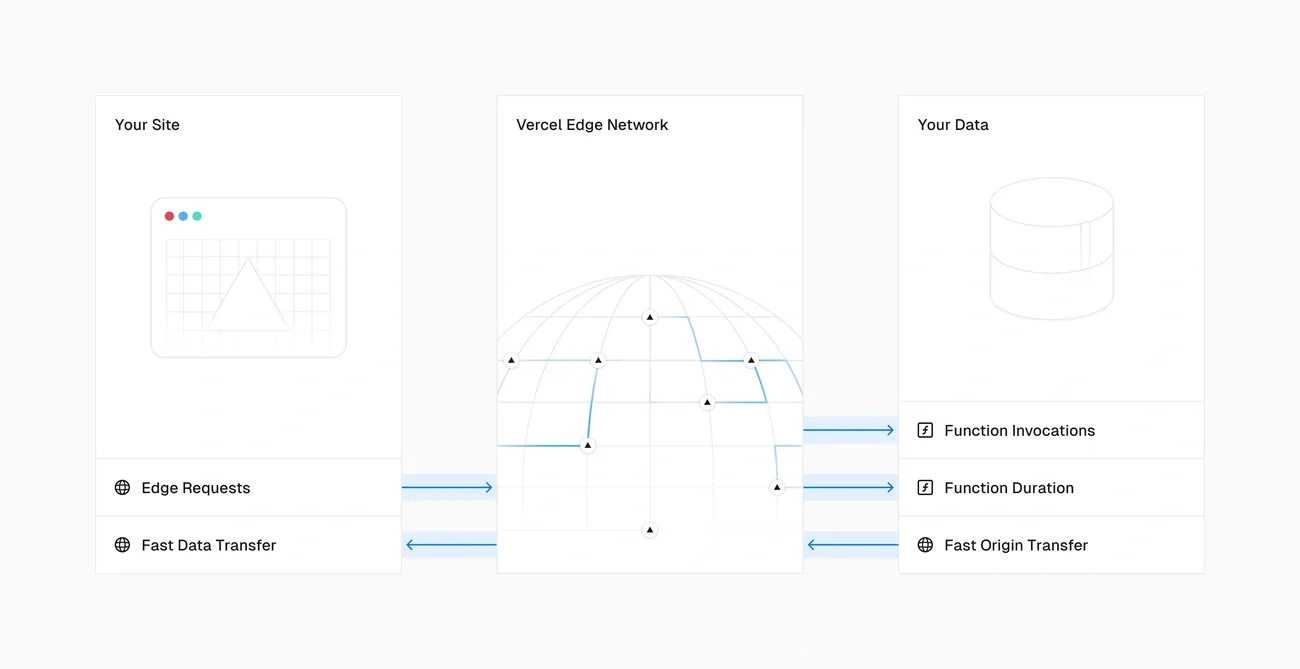
Image Source: Vercel
Vercel’s impressive valuation comes from its advanced infrastructure architecture that streamlines deployment efficiency. Their trailblazing solutions in this field have made them innovators in deployment technology.
Fluid Infrastructure Model: Serverless Elasticity with Stateful Performance
Vercel’s trailblazing Fluid compute model stands as the most important advancement beyond traditional serverless architectures. Their approach lets a single worker handle multiple requests at once, like in a traditional server, while keeping the elasticity of serverless functions [15]. The system helps early adopters cut compute costs by up to 85% [16] by maximizing existing resources before creating new instances. Traffic flows through a “compute-resolver” service that processes over 100,000 requests per second during peak times [17]. This architecture works especially well with AI workloads and eliminates the old compromise between scalability and efficiency.
Git-based Deployment with CLI and REST API Integration
Vercel’s deployment infrastructure offers multiple ways to integrate through Git providers, CLI tools, and a detailed REST API. The platform automates deployments whenever developers push code or merge into the production branch from GitHub, GitLab, Bitbucket, and Azure DevOps [18]. Developers can use Vercel’s REST API endpoints to manage deployments, domains, and environment variables through HTTP requests [19]. The CLI provides extra tools to retrieve logs, handle certificates, and replicate deployment environments on local machines [5].
Cloudflare and AWS Backbone for Global Edge Delivery
Their global edge network reaches 119 Points of Presence [link_2] in 94 cities across 51 countries [20]. This setup delivers content near users while running computations close to data sources. The infrastructure runs on AWS Lambda for function execution, and Vercel adds its own technology for TCP-based communication between components [17]. Enterprise customers can use specific Cloudflare integrations through Origin CA certificates with wildcard support when needed, though Vercel recommends against using reverse proxies like Cloudflare in front of their platform for performance reasons [6].
Strategic Acquisitions and Enterprise Adoption
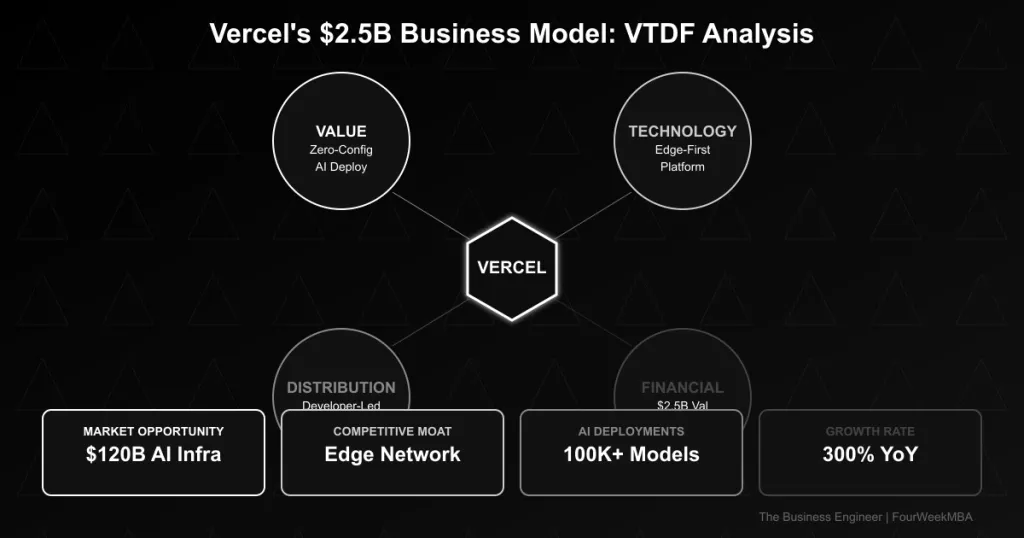
Image Source: FourWeekMBA
Vercel’s impressive $2.5 billion valuation stems from its smart acquisitions. The company has expanded its technical capabilities and secured major enterprise clients through targeted purchases.
Turborepo and Splitbee: Enhancing Developer Workflow
Vercel acquired Turborepo, a high-performance build system for JavaScript and TypeScript monorepos, in December 2021. This technology makes code sharing easier and optimizes build processes that reduces CI/CD times by up to 65% [4]. The company made Turborepo’s CLI open source under an MPL 2.0 license [21]. The company acquired Splitbee in October 2022, an analytics and conversion platform that helps brands track and optimize online businesses without compromising data integrity [22]. Splitbee’s privacy-friendly analytics collect data at the edge with zero third-party requests, which eliminates the need for extra scripts or cookies [22].
Tremor and NuxtLabs: Expanding Frontend Ecosystem
The company strengthened its position by acquiring Tremor, an open-source React component library [23], and NuxtLabs, creators of the Nuxt framework and Nitro server runtime [24]. NuxtLabs’ acquisition brought Sebastien Chopin (original Nuxt creator), Daniel Roe, Pooya Parsa, and Anthony Fu to the team [25]. Vercel managed to keep Nuxt’s independence and MIT license while providing financial stability for core team members [7].
Enterprise Clients: GitHub, Airbnb, IBM, and McDonald’s
These acquisitions’ technical sophistication has drawn attention from major enterprise clients. Companies like Carhartt, GitHub, Hulu, IBM, McDonald’s, Uber, and Facebook now deploy frontends with Vercel [26]. Their platform powers websites for global brands including Walmart, Apple, Nike, Netflix, TikTok, and Starbucks [27].
Conclusion
Vercel’s rapid rise to a $3.25 billion valuation shows proof of their technical excellence and market vision. The company has grown from a deployment tool into an end-to-end development platform serving major enterprises worldwide. Guillermo Rauch’s developer-centric philosophy has guided Vercel to create solutions that solve real pain points in modern web development.
Technical innovations make Vercel worth every penny of its valuation. Next.js now powers thousands of enterprise websites. New offerings like v0 and the AI SDK show how Vercel keeps redefining the limits of what’s possible. Their Fluid infrastructure model has set new standards for serverless computing. Users get both elasticity and performance without compromising either.
Smart acquisitions have without doubt strengthened Vercel’s position in the market. They bought Turborepo to optimize builds, Splitbee for privacy-focused analytics, Tremor for React components, and NuxtLabs to support more frameworks. These smart moves have expanded their technical capabilities while staying true to the open-source spirit developers love.
Enterprise adoption paints the clearest picture of success. GitHub, Airbnb, IBM, and McDonald’s trust Vercel with their frontend deployments. This speaks volumes about the platform’s reliability and performance. Their impressive client list and 300% year-over-year growth explain why investors keep betting on Vercel’s future.
Vercel proves how technical excellence mixed with developer empathy creates extraordinary business value. Their $2.5 billion valuation reflects both current success and their ability to shape web development’s future. AI-powered development speeds up and the need for optimized deployment infrastructure grows. Vercel looks ready to lead the way over the next several years.
Key Takeaways
Vercel’s $3.25 billion valuation is justified by strategic technical innovations and enterprise adoption that have redefined modern web development.
• AI-Powered Development Revolution: Vercel’s v0 platform transforms natural language into functional web apps, while their AI SDK achieves 2M+ weekly downloads, positioning them at the forefront of AI-driven development tools.
• Infrastructure Excellence Drives Cost Savings: The Fluid compute model reduces costs by up to 85% while maintaining serverless elasticity, supported by a global edge network spanning 119 locations across 51 countries.
• Strategic Acquisitions Expand Capabilities: Key acquisitions of Turborepo, Splitbee, Tremor, and NuxtLabs have systematically enhanced developer workflows and broadened framework support while maintaining open-source principles.
• Enterprise Trust Validates Market Position: Major clients including GitHub, Airbnb, IBM, McDonald’s, and Netflix rely on Vercel’s platform, demonstrating enterprise-grade reliability and performance at scale.
• Open Source Foundation Fuels Growth: Next.js powers 35,000+ sites and maintains strong developer community engagement, creating a sustainable competitive moat through ecosystem adoption.
The combination of technical innovation, strategic acquisitions, and proven enterprise adoption creates a compelling case for Vercel’s multi-billion dollar valuation in the rapidly evolving web development landscape.
FAQs
Q1. What is Vercel’s current valuation? Vercel’s valuation reached $3.25 billion after securing $250 million in funding in May 2024, demonstrating significant growth from its previous funding round in 2021.
Q2. What are some of Vercel’s key product innovations? Vercel has introduced several groundbreaking innovations, including v0 (a natural language to web app generator), an AI SDK for building conversational interfaces, and a Fluid infrastructure model that combines serverless elasticity with stateful performance.
Q3. How does Vercel’s deployment infrastructure stand out? Vercel’s deployment infrastructure features a global edge network spanning 119 Points of Presence across 94 cities, Git-based deployment with CLI and REST API integration, and a Fluid compute model that has helped reduce compute costs by up to 85% for early adopters.
Q4. Which major companies use Vercel’s platform? Vercel’s platform is trusted by numerous enterprise clients, including GitHub, Airbnb, IBM, McDonald’s, Uber, Walmart, Apple, Nike, Netflix, and TikTok, for deploying their frontends and powering their websites.
Q5. How has Vercel expanded its capabilities through acquisitions? Vercel has made strategic acquisitions to enhance its offerings, including Turborepo for optimizing build processes, Splitbee for privacy-friendly analytics, Tremor for React components, and NuxtLabs to expand framework support while maintaining open-source principles.
References
[1] – https://machalliance.org/membership-benefits
[2] – https://www.acquired.fm/episodes/building-web-apps-with-just-english-and-ai-with-vercel-ceo-guillermo-rauch
[3] – https://machalliance.org/insights-hub/spotlight-on-enablers-how-vercel-supports-mach-stack-adoption
[4] – https://www.businesswire.com/news/home/20211209005455/en/Vercel-Announces-Acquisition-of-Turborepo-Accelerating-the-Speed-of-Web-Development-and-Delivery-by-Eliminating-Complexity-in-Frontend-Codebase-Scalability
[5] – https://vercel.com/docs/cli
[6] – https://vercel.com/guides/cloudflare-with-vercel
[7] – https://masteringnuxt.com/blog/vercel-acquired-nuxtlabs-what-this-means-for-the-future-of-nuxt
[8] – https://medium.com/ably-realtime/socket-io-deep-dive-8a6a4d0877de
[9] – https://vercel.com/oss
[10] – https://vercel.com/blog/build-your-own-ai-app-builder-with-the-v0-platform-api
[11] – https://vercel.com/docs/v0
[12] – https://vercel.com/blog/ai-sdk-5
[13] – https://vercel.com/docs/ai-sdk
[14] – https://vercel.com/blog/introducing-chat-sdk
[15] – https://www.infoq.com/news/2025/03/vercel-fluid/
[16] – https://vercel.com/blog/introducing-fluid-compute
[17] – https://vercel.com/blog/fluid-how-we-built-serverless-servers
[18] – https://vercel.com/docs/git
[19] – https://vercel.com/docs/rest-api
[20] – https://vercel.com/docs/edge-network
[21] – https://vercel.com/blog/vercel-acquires-turborepo
[22] – https://www.businesswire.com/news/home/20221025005915/en/Vercel-Acquires-Splitbee-to-Expand-Its-First-Party-Privacy-Friendly-Analytics-Offering
[23] – https://venturekites.com/vercel-this-startup-is-quietly-powering-the-internet-and-youve-probably-used-it-without-knowing/
[24] – https://vercel.com/blog/nuxtlabs-joins-vercel
[25] – https://thenewstack.io/creators-of-nuxt-js-and-nitro-join-vercel/
[26] – https://www.businesswire.com/news/home/20211123005573/en/Vercel-Announces-%24150M-in-Series-D-Funding-at-a-%242.5B-Valuation-to-Further-Fuel-Innovation-and-Global-Adoption-of-Worlds-Fastest-Frontend-Development-Platform
[27] – https://research.contrary.com/company/vercel