
Artificial intelligence is transforming how businesses operate, and CTOs must stay ahead of rapidly evolving technologies to maintain competitive advantage. The year 2025 brings unprecedented opportunities as AI agents become autonomous task executors and multimodal AI systems process text, images, audio, and video simultaneously.
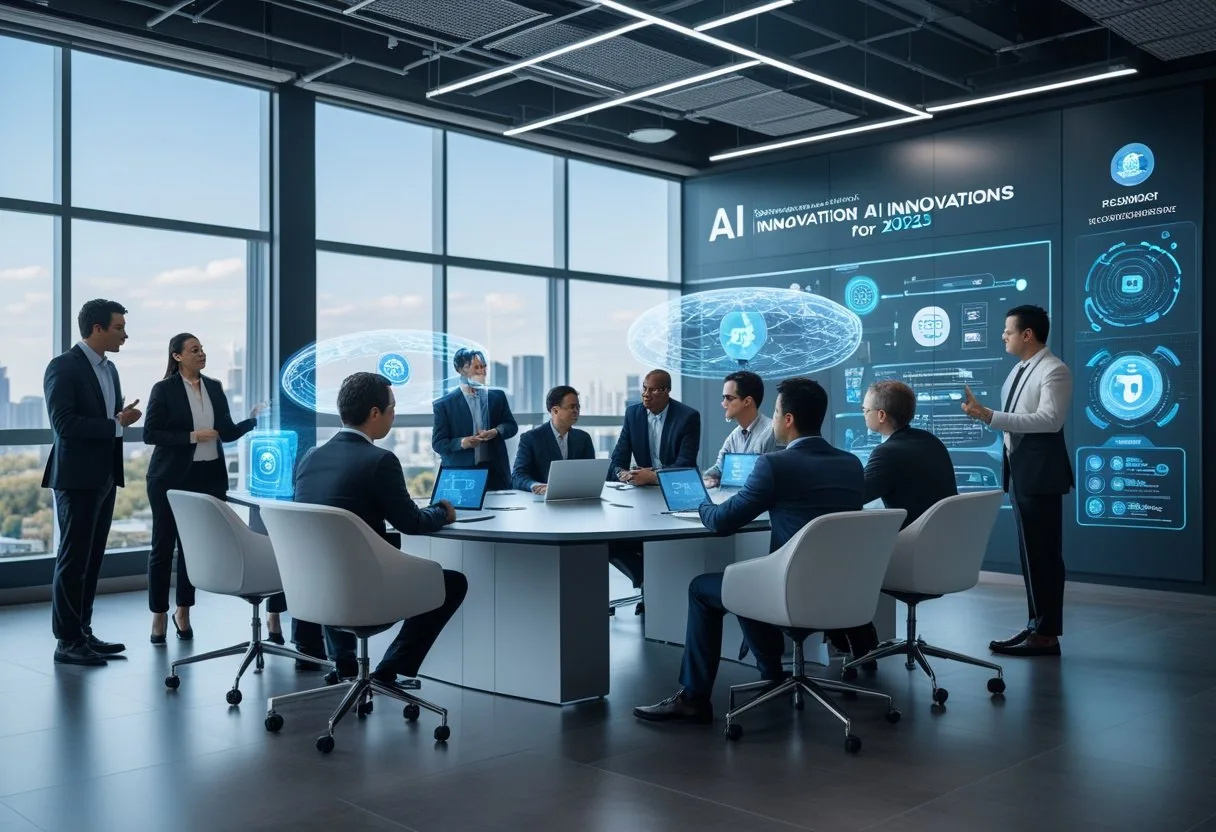
CTOs who understand and implement these emerging AI innovations will position their organizations to leverage breakthrough technologies that fundamentally change how work gets done. From smaller language models that reduce costs to quantum computing applications and edge-based processing, the landscape demands strategic decision-making around technology adoption.
The convergence of advanced connectivity, immersive experiences, and democratized AI tools creates new possibilities for business transformation. Organizations that prepare now for these technological shifts will capture significant advantages in efficiency, innovation, and market positioning.
Key Takeaways
- CTOs must adapt their leadership approach to guide autonomous AI systems and quantum-powered applications
- Advanced AI technologies like multimodal processing and edge computing will fundamentally change business operations
- Strategic preparation for emerging platforms and sustainable AI practices determines long-term competitive success
The Evolving Role of CTOs in AI Leadership

CTOs now serve as trust leaders and strategic translators who bridge technical capabilities with business value. They focus on building AI governance frameworks while enabling cross-functional teams to adopt AI tools with confidence.
Strategic Priorities for Chief Technology Officers
The modern CTO role extends beyond technical implementation to encompass three critical functions. CTOs must act as Chief Trust Officers, Chief Translators, and Chief Enablers within their organizations.
Chief Trust Officer responsibilities include establishing reliable AI systems that align with company values. CTOs must demonstrate that AI tools are secure and dependable across all business functions.
Chief Translator duties involve converting complex AI technologies into clear business benefits. CTOs help executives understand how predictive analytics and machine learning create strategic value.
Chief Enabler functions focus on smooth technology adoption through robust infrastructure and training programs. 42% of CTOs cite managing people and teams as their biggest challenge over the next 12 months.
Employee education remains essential for successful AI adoption. Organizations like Amazon have launched comprehensive reskilling initiatives to prepare their workforce for AI integration.
Enabling Competitive Advantage Through AI
CTOs create competitive advantage by implementing AI solutions that complement human expertise rather than replace it. They must ensure AI tools generate measurable business impact while minimizing risks.
Building trust requires transparency in data usage and clear communication about AI capabilities. 57% of employees admit to hiding their AI tool usage from leadership, indicating a cultural gap that CTOs must address.
Key competitive strategies include:
- Deploying AI agents that enable employees across multiple job profiles to streamline processes
- Creating cross-functional collaboration through shared AI platforms
- Establishing training programs that build employee confidence with AI tools
- Developing infrastructure that supports organization-wide AI adoption
CTOs who successfully bridge the trust gap transform AI from a risky investment into a sustainable business advantage. They focus on solutions tailored to specific team needs rather than generic implementations.
AI Governance and Ethical Frameworks
Effective AI governance requires CTOs to establish clear frameworks for data usage, risk management, and ethical principles. These frameworks guide how AI is developed, deployed, and measured against business objectives.
C-suite confidence in AI strategy dropped from 69% in 2024 to 58% in 2025, highlighting the need for stronger governance structures.
Essential governance components include:
- Data accuracy standards that ensure reliable AI inputs and outputs
- Bias detection protocols that maintain fairness in AI decision-making
- Compliance monitoring that meets regulatory requirements
- Cross-functional oversight through AI governance councils or task forces
Many organizations formalize governance through dedicated committees that oversee AI ethics and implementation standards. These groups ensure AI applications align with company values and regulatory requirements.
CTOs must create transparent processes that help employees understand AI limitations and appropriate use cases. Clear governance builds organizational confidence and enables responsible AI adoption across all business functions.
Breakthroughs in Artificial Intelligence and Machine Learning

Artificial intelligence continues advancing through major improvements in generative models, foundation architectures, and learning efficiency. These developments enable AI systems to create content, understand complex patterns, and learn from minimal training data with unprecedented capability.
Generative AI Adoption and Applications
Generative AI has moved beyond simple text and image creation into sophisticated virtual environments. Generative virtual playgrounds represent the next evolution, where AI creates entire interactive worlds from single images.
Google DeepMind’s Genie 2 transforms starter images into complete virtual environments. Companies like Decart and Etched developed AI-powered Minecraft experiences where every frame generates in real-time during gameplay.
Key Applications Include:
- Game Development: Converting sketches into playable environments instantly
- Robot Training: Creating unlimited virtual scenarios for machine learning
- Design Prototyping: Testing concepts through interactive simulations
World Labs focuses on large world models (LWMs) for spatial intelligence. This technology helps machines understand and interact with physical environments more effectively.
The gaming industry benefits from rapid prototyping capabilities. Developers can explore new concepts without traditional development timelines or resource constraints.
Foundation Models and Transformer Architectures
OpenAI’s o1 model introduced step-by-step reasoning capabilities that fundamentally changed how large language models process information. Unlike previous models that generate immediate responses, these systems break complex problems into smaller components.
Large language models that “reason” show improved accuracy in mathematics, physics, and logic problems. Google DeepMind’s Gemini 2.0 Flash Thinking uses similar approaches for enhanced problem-solving.
Technical Improvements:
| Feature | Traditional Models | Reasoning Models |
|---|---|---|
| Response Method | Immediate output | Step-by-step processing |
| Problem Solving | Single attempt | Multiple approaches |
| Accuracy | Variable | Improved for complex tasks |
These architectures power more capable AI agents. Google’s Mariner agent demonstrates advanced web browsing by adapting when encountering obstacles and finding alternative solutions.
Neural networks benefit from transformer improvements that enable better context understanding. Deep learning systems now handle longer sequences and maintain coherence across extended interactions.
Self-Supervised, Few-Shot, and Zero-Shot Learning
Machine learning efficiency has improved dramatically through advanced learning techniques that require minimal training data. Self-supervised learning allows models to learn patterns from unlabeled data without human annotation.
Few-shot learning enables AI systems to perform new tasks with only a handful of examples. This approach reduces training time and computational requirements significantly compared to traditional methods.
Learning Efficiency Comparison:
- Traditional ML: Requires thousands of labeled examples
- Few-Shot: Performs well with 5-10 examples
- Zero-Shot: Works without task-specific training data
Zero-shot learning represents the most advanced capability, where models apply existing knowledge to completely new scenarios. This breakthrough reduces deployment costs and accelerates AI implementation across industries.
Foundation models trained on diverse datasets enable these learning approaches. The broad knowledge base allows systems to generalize effectively to unfamiliar tasks without extensive retraining.
AI companies continue advancing these techniques to create more adaptable and efficient artificial intelligence systems. The combination of improved architectures and learning methods drives practical AI applications forward.
Quantum Computing: Transformative Power for AI
Quantum algorithms are fundamentally changing how AI models process complex calculations, while quantum-resistant cryptography becomes essential for protecting AI systems. Cloud platforms are already integrating quantum capabilities to make this technology accessible to enterprise CTOs.
Quantum Algorithms Accelerating AI and ML
Quantum computing processes information exponentially faster than classical computers for specific AI tasks. Quantum machine learning algorithms can handle massive datasets that would overwhelm traditional systems.
Key quantum advantages for AI include:
- Training acceleration: Deep learning models train significantly faster using quantum optimization
- Pattern recognition: Quantum superposition enables simultaneous analysis of multiple data states
- Complex problem solving: Financial modeling and molecular simulations become computationally feasible
Drug discovery applications are already emerging, where quantum-AI systems simulate protein interactions at atomic levels. This reduces pharmaceutical research timelines from years to months.
CTOs should monitor quantum machine learning frameworks like PennyLane and Cirq. These tools bridge classical AI workflows with quantum processors.
Cryptography and Data Security Implications
Quantum computers threaten current encryption methods that protect AI training data and model parameters. RSA and elliptic curve cryptography will become vulnerable to quantum attacks.
Immediate security concerns:
- AI model theft: Proprietary algorithms lose protection from quantum decryption
- Training data exposure: Sensitive datasets become accessible to quantum-powered attacks
- Communication channels: API calls between AI services need quantum-resistant protocols
Organizations must transition to quantum-resistant cryptography before widespread quantum adoption. Post-quantum cryptographic standards like CRYSTALS-Dilithium offer protection against both classical and quantum threats.
CTOs should audit existing AI infrastructure for cryptographic dependencies. Many legacy systems require updates to support quantum-safe algorithms.
Quantum Cloud Integration Strategies
Major cloud providers are integrating quantum processing units into their AI platforms. AWS Braket, Google Quantum AI, and IBM Quantum Network offer quantum cloud solutions for enterprise customers.
Integration approaches:
| Strategy | Use Case | Implementation |
|---|---|---|
| Hybrid processing | Complex optimization | Classical preprocessing + quantum acceleration |
| Quantum simulators | Algorithm testing | Cloud-based quantum emulation |
| API integration | Specific calculations | Quantum calls within existing AI workflows |
Quantum cloud services enable experimentation without hardware investments. CTOs can test quantum algorithms using cloud-based quantum computers before committing to on-premise solutions.
Early adoption strategies include identifying specific AI workloads that benefit from quantum acceleration. Portfolio optimization, route planning, and molecular modeling represent immediate opportunities for quantum-AI integration.
Cloud and Edge Ecosystems for Scalable AI Deployment
Modern AI deployment requires distributed infrastructure that spans cloud data centers and edge locations. Organizations need multi-cloud strategies, real-time edge processing capabilities, and automated orchestration tools to manage complex AI workloads efficiently.
Distributed Cloud and Multi-Cloud Architectures
Distributed cloud computing extends cloud services to multiple geographic locations while maintaining centralized management. This approach allows organizations to deploy AI workloads closer to data sources and users.
Multi-cloud strategies provide flexibility and reduce vendor lock-in. Companies can use AWS for training, Google Cloud for inference, and Microsoft Azure for data storage based on specific strengths.
Key distributed cloud solutions include:
- AWS Outposts for on-premises cloud infrastructure
- Azure Stack for hybrid deployments
- Google Anthos for multi-cloud management
Cloud architecture patterns for AI include:
| Pattern | Use Case | Benefits |
|---|---|---|
| Hub and Spoke | Centralized training, distributed inference | Cost efficiency, data governance |
| Mesh Network | Peer-to-peer model sharing | Reduced latency, fault tolerance |
| Federated Learning | Privacy-preserving training | Compliance, data sovereignty |
Organizations typically see 30-50% cost reductions when implementing distributed cloud solutions for AI workloads.
Edge Computing for Real-Time AI
Edge computing brings AI processing to the data source, enabling millisecond response times for critical applications. This approach reduces bandwidth costs and improves application performance.
Edge AI hardware includes specialized processors designed for inference workloads. NVIDIA Jetson devices power autonomous vehicles. Intel Movidius chips enable smart cameras. Google Coral TPUs support IoT applications.
Real-time AI applications benefit most from edge deployment:
- Industrial automation with predictive maintenance
- Autonomous vehicles requiring instant decision-making
- Smart retail with computer vision analytics
- Healthcare monitoring with continuous patient data analysis
Edge proximity drives the need for distributed, interconnected, and scalable AI infrastructure.
Model optimization techniques reduce computational requirements. Quantization shrinks model size by 75%. Pruning removes unnecessary neural network connections. Knowledge distillation creates smaller models from larger ones.
Edge AI deployment unlocks new opportunities for innovation and enhances decision-making processes across industries.
DevOps and Orchestration for AI Workflows
AI workflows require specialized DevOps practices that handle model training, testing, and deployment at scale. Traditional software deployment methods cannot manage the complexity of AI model lifecycles.
MLOps platforms automate model management across cloud and edge environments. Kubeflow provides Kubernetes-native machine learning workflows. MLflow tracks experiments and manages model versions. Apache Airflow orchestrates complex data pipelines.
Container orchestration enables consistent AI deployments:
- Kubernetes manages containerized AI workloads
- Docker packages models with dependencies
- Helm charts simplify deployment configurations
Continuous integration for AI includes automated testing of model accuracy, performance benchmarks, and bias detection. Models deploy automatically when they meet quality thresholds.
Monitoring and observability tools track model performance in production. Prometheus collects metrics from distributed AI systems. Grafana visualizes performance dashboards. Custom alerts notify teams of model drift or performance degradation.
Organizations deploying AI applications in diverse environments need scalable, flexible, and high-performance infrastructure that spans edge to cloud deployments.
Harnessing 5G, IoT, and Next-Gen Connectivity
High-speed 5G networks enable real-time AI processing for autonomous vehicles and industrial automation. IoT sensors across smart cities generate massive datasets that AI systems analyze to optimize traffic, energy consumption, and public services.
5G Networks Driving AI Applications
5G networks deliver up to 10 Gbps download speeds with latency as low as 1 millisecond. This ultra-fast connectivity transforms how AI applications process data in real-time scenarios.
Autonomous vehicles benefit most from this combination. AI algorithms need instant access to traffic data, weather conditions, and road hazards. 5G networks provide the speed required for split-second decision making.
Manufacturing plants use 5G-powered AI to monitor production lines. Sensors collect data from machinery and robots. AI systems analyze this information immediately to prevent equipment failures and optimize output.
Key 5G capabilities for AI:
- Enhanced bandwidth for processing large datasets
- Low latency enabling real-time responses
- Network slicing for dedicated AI workloads
- Edge computing bringing AI processing closer to devices
Healthcare applications leverage 5G for remote patient monitoring. Wearable devices transmit vital signs instantly to AI systems that detect anomalies and alert medical staff.
IoT-Enabled Smart Cities and Infrastructure
Smart cities integrate thousands of IoT sensors with AI systems to manage urban operations. These connected devices monitor everything from air quality to pedestrian traffic patterns.
Traffic management systems use IoT sensors at intersections and highways. AI analyzes this data to adjust signal timing and reduce congestion. Cities report 20-30% improvements in traffic flow with these systems.
Energy grids become more efficient through IoT-AI integration. Smart meters track power consumption across neighborhoods. AI predicts demand spikes and automatically adjusts energy distribution.
Smart city IoT applications include:
- Air quality sensors for pollution monitoring
- Smart parking systems reducing search time
- Water leak detection preventing infrastructure damage
- Public safety cameras with AI threat detection
Waste management benefits from IoT sensors in garbage bins. These devices monitor fill levels and optimize collection routes. AI scheduling reduces fuel costs and improves service efficiency.
Public transportation uses IoT for predictive maintenance. Sensors on buses and trains detect mechanical issues before they cause breakdowns. AI systems schedule repairs during off-peak hours to minimize service disruptions.
Immersive Experiences: AR, VR, and Extended Reality in Business
AI-powered immersive technologies are creating new ways for businesses to train employees, design products, and interact with customers. Extended reality market growth of 28.3% CAGR through 2029 demonstrates strong enterprise adoption across multiple industries.
Augmented Reality for Enhanced Productivity
Augmented reality transforms workplace efficiency by overlaying digital information onto real environments. Manufacturing workers use AR glasses to access assembly instructions and quality control data without stopping their tasks.
Healthcare professionals leverage AR for surgical guidance and patient data visualization. Medical professionals use AR platforms like XRAI for real-time 3D visualizations during complex procedures, improving accuracy and reducing operation times.
Construction teams employ AR for project planning and safety training. Workers can visualize building plans directly on construction sites and identify potential hazards before they occur.
Key AR Applications:
- Smart Glasses: 1,380 companies developing smart glasses solutions with 27.92% annual growth
- Maintenance Support: Technicians receive step-by-step repair guidance
- Remote Assistance: Experts guide field workers through complex procedures
Virtual Reality and XR Solutions
Virtual reality creates controlled environments for employee training and product development. Companies use VR simulations to train workers in high-risk scenarios without safety concerns.
Real estate firms deploy VR for property showcases and virtual tours. Smart city virtual models help urban planners test scenarios and design spaces before physical construction begins.
XR platforms combine AR and VR capabilities for hybrid business solutions. Teams collaborate in virtual workspaces while maintaining connections to physical operations.
Enterprise VR Benefits:
- Reduced training costs by 40-60%
- Improved knowledge retention rates
- Safe practice environments for dangerous tasks
- Global team collaboration capabilities
AI in Autonomous Vehicles and Advanced Interfaces
AI enhances XR experiences through personalized content and adaptive interfaces. AI-powered XR personalizes user experiences while 5G enables seamless streaming for mobile applications.
Autonomous vehicles integrate AR displays for navigation and safety alerts. Drivers receive real-time traffic information and hazard warnings through windshield displays.
Haptic technology with 900+ companies developing solutions adds touch feedback to virtual interfaces. Users feel texture and resistance in digital environments, improving interaction quality.
AI Integration Features:
- Adaptive Learning: Systems adjust to user behavior patterns
- Predictive Analytics: Anticipate user needs and preferences
- Natural Language Processing: Voice commands for hands-free operation
- Computer Vision: Real-time object recognition and tracking
Enabling Secure, Sustainable, and Responsible AI
Modern AI systems require built-in privacy protections, zero-trust security frameworks, and energy-efficient computing approaches. CTOs must balance innovation with environmental responsibility while maintaining robust cybersecurity standards.
Data Privacy by Design
Privacy-first AI architecture embeds data protection into every layer of system development. This approach prevents sensitive information from being exposed during model training or inference.
Differential privacy adds mathematical noise to datasets. This technique allows AI models to learn patterns without accessing individual data points. Companies like Apple use differential privacy to protect user information while improving services.
Federated learning trains models across distributed devices without centralizing data. Healthcare organizations use this method to develop diagnostic AI while keeping patient records on local servers. The model learns from aggregated insights rather than raw medical data.
Data minimization limits collection to only necessary information. AI systems should process the smallest dataset required for accurate results. This reduces privacy risks and storage costs.
Encryption during processing protects data even when AI systems analyze it. Homomorphic encryption allows computations on encrypted data without decrypting it first. Financial institutions use this technology for fraud detection without exposing transaction details.
Cybersecurity and Zero Trust for AI Systems
Zero trust security assumes no component of an AI system is inherently trustworthy. Every access request requires verification regardless of location or previous authentication.
Model integrity protection prevents adversarial attacks that manipulate AI outputs. Attackers can subtly alter input data to cause misclassification. Image recognition systems might incorrectly identify stop signs if pixels are modified imperceptibly.
API security controls access to AI services through authentication tokens and rate limiting. Machine learning APIs need protection against data poisoning attacks where malicious training data corrupts model behavior.
Continuous monitoring tracks AI system performance for unusual patterns. Behavioral analytics detect when models deviate from expected outputs. This helps identify potential security breaches or system compromises.
Infrastructure isolation separates AI workloads from other systems. Containerized deployments limit blast radius if attacks occur. Microsoft emphasizes layered security approaches in their responsible AI framework.
Sustainable Technologies and Renewable Energy
Energy-efficient AI reduces computational costs and environmental impact. Sustainable AI practices align technological innovation with climate goals while maintaining performance standards.
Model optimization techniques reduce energy consumption without sacrificing accuracy. Pruning removes unnecessary neural network connections. Quantization reduces precision of model weights to decrease memory usage and processing power.
Edge computing processes data locally instead of sending it to distant data centers. This reduces network traffic and latency while cutting energy usage. Smart cameras can run object detection models directly on device processors.
Renewable energy integration powers AI infrastructure with clean sources. Major cloud providers now offer carbon-neutral computing options. Data centers increasingly use solar and wind power for training large language models.
Green algorithms prioritize efficiency during development. Researchers design neural architectures that achieve better results with fewer computational resources. These approaches reduce both training time and operational costs.
Hardware acceleration through specialized chips improves performance per watt. Graphics processing units and tensor processing units handle AI workloads more efficiently than general-purpose processors.
Future-Ready Platforms and AI Democratization
Organizations are rapidly adopting no-code solutions that enable business users to build AI applications without programming expertise. Cloud platforms from major providers now offer specialized AI development environments that accelerate deployment timelines from months to weeks.
No-Code and Low-Code Platforms for Rapid Prototyping
No-code platforms have transformed how organizations approach AI development. Business analysts and domain experts can now create functional AI prototypes without writing code.
These platforms provide drag-and-drop interfaces for building machine learning workflows. Users connect data sources, apply pre-trained models, and create custom applications through visual programming.
Key capabilities include:
- Pre-built AI model libraries
- Visual workflow designers
- Automated data preprocessing
- One-click deployment options
Microsoft Power Platform exemplifies this trend with Power Apps AI Builder. The tool enables users to create AI-powered applications using templates and guided wizards.
Companies report 50-70% faster prototype development using these platforms. IT teams can focus on complex integrations while business users handle routine AI implementations.
The democratization of AI will accelerate in 2025 as barriers to entry continue falling. Organizations no longer need specialized AI teams to experiment with intelligent automation.
AI-Augmented Development and Industry Cloud Solutions
Industry cloud solutions now embed AI capabilities directly into sector-specific workflows. Healthcare clouds include diagnostic AI tools, while financial services platforms offer fraud detection models.
Microsoft Azure offers industry-specific AI services through vertical cloud solutions. These platforms combine domain expertise with pre-configured AI models for faster time-to-value.
Development acceleration features:
- Code generation from natural language prompts
- Automated testing and debugging
- Intelligent code completion
- Real-time performance optimization
AI-augmented development tools reduce coding time by up to 40%. Developers describe requirements in plain language, and platforms generate functional code automatically.
Cloud providers now offer specialized AI infrastructure that scales automatically based on workload demands. This eliminates the need for organizations to manage complex hardware configurations or capacity planning.
The shift toward industry clouds creates new opportunities for rapid AI adoption across vertical markets.
Frequently Asked Questions
CTOs face complex decisions about AI implementation strategies, from integrating machine learning into development workflows to addressing privacy concerns. These questions address practical challenges around legacy system integration, emerging applications, and the evolving landscape of AI-driven business transformation.
How is AI impacting software development processes and decision-making in 2025?
AI tools now automate code generation, bug detection, and testing workflows across development teams. Machine learning models analyze codebases to suggest optimizations and identify security vulnerabilities before deployment.
Development cycles accelerate through AI-powered code completion and automated documentation generation. Teams use predictive analytics to estimate project timelines and resource allocation more accurately.
AI assists in architectural decisions by analyzing system performance patterns and recommending infrastructure changes. Code review processes integrate machine learning to flag potential issues and maintain coding standards.
What are the emerging ethical considerations for AI deployment in enterprise environments?
Bias mitigation requires structured testing across different demographic groups and use cases. Companies implement audit trails and model documentation to ensure transparent decision-making processes.
Data privacy regulations demand explicit consent mechanisms and clear data lineage tracking. Organizations establish governance frameworks that define acceptable AI use cases and risk thresholds.
Algorithmic accountability becomes critical as AI implementation in business depends on clear risk appetite. Companies create oversight committees to monitor AI system performance and ethical compliance.
Which novel AI applications are driving business innovation across industries this year?
Generative AI transforms content creation, from automated report generation to personalized marketing materials. Manufacturing adopts AI-powered predictive maintenance to reduce equipment downtime and optimize production schedules.
Financial services deploy machine learning for real-time fraud detection and risk assessment. Healthcare organizations use AI to analyze medical imaging and assist in diagnostic processes.
Retail companies implement AI-driven inventory management and demand forecasting systems. Supply chain optimization through machine learning reduces costs and improves delivery accuracy.
What strategies are leading companies adopting to integrate AI into their legacy systems?
API-first approaches allow gradual integration without complete system overhauls. Companies create data pipelines that connect legacy databases to modern AI platforms through middleware solutions.
Microservices architecture enables organizations to add AI capabilities incrementally to existing applications. Cloud-based AI services reduce infrastructure requirements while maintaining compatibility with on-premise systems.
Hybrid deployment models balance security requirements with AI functionality. Organizations establish separate environments for AI experimentation while protecting core business systems.
How are advancements in AI contributing to data security and privacy solutions?
AI-powered threat detection systems identify unusual network patterns and potential security breaches in real-time. Machine learning models analyze user behavior to detect unauthorized access attempts.
Automated compliance monitoring ensures data handling meets regulatory requirements across different jurisdictions. AI systems classify and tag sensitive data to enforce appropriate security protocols.
Privacy-preserving techniques like federated learning allow model training without centralizing sensitive data. Differential privacy methods add statistical noise to protect individual privacy while maintaining data utility.
What role is AI playing in the enhancement of customer experience and personalization?
Recommendation engines analyze customer behavior patterns to suggest relevant products and services. Chatbots and virtual assistants provide 24/7 customer support with natural language processing capabilities.
Dynamic pricing algorithms adjust costs based on demand, inventory, and customer segments. AI personalizes website content, email campaigns, and mobile app experiences in real-time.
Predictive analytics anticipate customer needs and proactively address potential service issues. Voice recognition and sentiment analysis improve call center efficiency and customer satisfaction metrics.