

Video games have undergone dramatic changes since their early days, but nothing has transformed the industry quite like artificial intelligence. AI is revolutionizing every aspect of gaming, from creating smarter non-player characters and adaptive gameplay to generating entire worlds and personalizing experiences for individual players. What started as simple computer-controlled enemies has evolved into sophisticated systems that can learn, adapt, and respond to players in real-time.

The impact of AI in video games extends far beyond just making enemies harder to beat. Game developers now use artificial intelligence to create procedural content, test games automatically, and even generate art and dialogue. Players experience more immersive worlds where characters react naturally and storylines adapt based on their choices and playing style.
This transformation touches every part of the gaming experience. From the moment players start a game, AI systems work behind the scenes to adjust difficulty levels, create personalized challenges, and ensure engaging gameplay. The technology has become so advanced that AI is changing how games are created, played, and monetized across all gaming platforms and genres.
Key Takeaways
- AI creates smarter characters and adaptive gameplay that responds to individual player behavior and skill levels
- Game developers use artificial intelligence to automatically generate content, test games, and create personalized gaming experiences
- The technology transforms storytelling by enabling dynamic narratives and immersive worlds that adapt in real-time
The Rise of AI in Video Game Development

AI technologies have moved from simple computer-controlled enemies to sophisticated systems that create entire game worlds and adapt to player behavior. Game developers are using AI to make video games more realistic, more complex, and more challenging, fundamentally changing how games are built and played.
The Evolution of AI in Gaming
AI has existed in video games for decades, but its role has expanded dramatically. Early games used basic scripted behaviors for enemies and characters.
Traditional AI Elements:
- Non-player characters (NPCs) controlled by simple rule sets
- Basic enemy patterns that followed predictable movements
- Static difficulty levels set by developers
Modern AI systems create dynamic experiences that change based on player actions. Dynamic difficulty adjustment analyzes whether a game is too easy or hard and makes adjustments to keep players engaged.
Games like Left4Dead use an “AI Director” to manage game pacing. This system watches how players perform and adjusts enemy spawns and item placement in real time.
Procedural content generation allows games to create new levels or maps automatically. No Man’s Sky generates entire planets and environments using AI algorithms.
AI Technologies Shaping the Industry
Several key AI technologies are transforming video game development. Large language models now power NPC dialogue systems that respond naturally to player input.
Core AI Technologies:
- Neural networks for graphics processing and rendering
- Machine learning for player behavior analysis
- Generative AI for content creation
- Computer vision for augmented reality games
Ubisoft incorporated generative AI into a prototype role-playing game where a large language model improvises dialogue for NPCs on the fly. This creates unique conversations that never repeat exactly.
Graphics processing has advanced through neural rendering. Technologies like nVidia’s DLSS 4 use AI to improve frame rates and reduce lag without requiring more powerful hardware.
A startup called Ovomind plans to release a wristband that measures players’ stress and excitement levels. The device will use AI to adjust game difficulty and pacing based on emotional responses.
Impact on Game Developers
AI is changing how game developers work and what skills they need. More than half of game industry workers now use AI tools in their daily work.
Developer Tool Applications:
- Script generation for game logic and events
- Asset creation for textures, models, and animations
- Quality assurance testing through automated gameplay
- Code optimization and bug detection
Game developers can use generative AI-based tools to create scripts, images, and objects and to perform quality assurance testing. This speeds up development cycles and reduces costs.
However, AI adoption raises concerns about job displacement. Microsoft recently announced layoffs in its gaming division as AI tools handle tasks previously done by humans.
Quality assurance testing particularly benefits from AI automation. Testing the same game scenarios hundreds of times is repetitive work that AI can perform more efficiently than human testers.
The video game industry now requires developers to understand AI tools and integration. Traditional programming skills remain important, but knowledge of machine learning and AI systems has become valuable.
AI-Powered Game Design and Mechanics
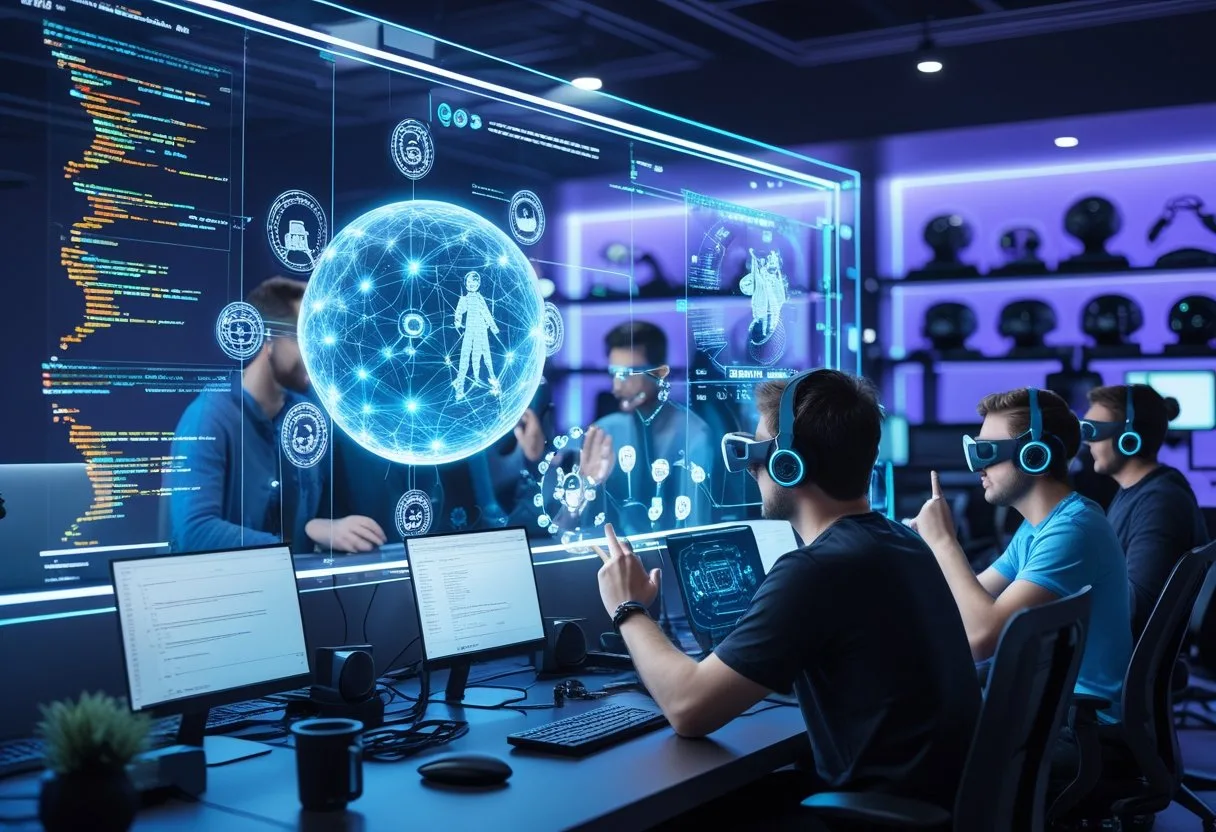
AI is revolutionizing game design and mechanics by automating complex processes that once required extensive manual work. These systems now generate vast game worlds, adapt gameplay in real-time, streamline testing procedures, and optimize performance automatically.
Procedural Generation and Dynamic Environments
Procedural generation uses AI algorithms to create game content automatically rather than designing everything by hand. This technology has transformed how developers build open-world games and expansive environments.
Traditional procedural generation often produced random, disconnected content. Modern AI systems create more coherent and meaningful worlds by understanding context and player behavior.
AI-assisted procedural content generation can produce:
- Terrain and landscapes that feel natural and varied
- Building layouts that make logical sense
- Quest structures that adapt to player choices
- Weather systems that respond to gameplay events
Game developers now use machine learning to analyze successful level designs. The AI systems learn patterns and apply them to generate new content that feels hand-crafted.
Dynamic environments change based on player actions and AI decision-making. Trees might grow over time, cities expand based on player choices, or landscapes shift according to in-game events.
This approach allows smaller development teams to create massive game worlds. Players experience unique content each time they play, extending the life of games significantly.
AI-Driven Game Mechanics
AI systems now control core game mechanics that adapt to individual players in real-time. These mechanics create personalized gaming experiences that respond to player skill level and preferences.
Adaptive difficulty systems monitor player performance continuously. When players struggle with challenges, the AI subtly adjusts enemy behavior, puzzle complexity, or resource availability.
Smart NPC behavior has evolved beyond simple scripted responses. Living NPCs can now respond fluidly to player questions using natural language processing.
| Traditional NPCs | AI-Powered NPCs |
|---|---|
| Fixed dialogue trees | Dynamic conversations |
| Preset behavior patterns | Adaptive responses |
| Limited interaction options | Open-ended discussions |
Emergent gameplay occurs when AI systems interact in unexpected ways. Multiple AI-driven mechanics can combine to create scenarios that developers never specifically programmed.
Combat systems use AI to make enemies learn from player tactics. Stealth games employ AI that remembers player hiding spots and adapts patrol routes accordingly.
Automating Game Testing and Quality Assurance
AI tools significantly support QA teams by handling repetitive testing tasks that would take human testers countless hours to complete manually.
Automated playtesting uses AI agents that play games continuously. These systems can test thousands of gameplay scenarios overnight, identifying bugs and balance issues.
AI testing covers multiple areas:
- Performance bottlenecks in different hardware configurations
- Game balance by simulating various player strategies
- Progression systems to ensure proper pacing
- Collision detection and physics interactions
Bug detection algorithms scan code and gameplay footage to identify visual glitches, audio problems, and gameplay inconsistencies. Machine learning models trained on previous bug reports can predict where new issues might occur.
Human testers focus on creative problem-solving and subjective feedback while AI handles systematic verification. This combination improves game quality while reducing development time.
Optimizing Game Performance with AI
AI systems analyze game performance data to optimize resource usage and maintain smooth gameplay across different devices and platforms.
Resource management algorithms monitor CPU, GPU, and memory usage in real-time. When performance drops, these systems automatically adjust graphics settings, reduce particle effects, or optimize asset loading.
Predictive loading uses machine learning to anticipate what game content players will encounter next. The system preloads assets before they’re needed, reducing loading times and maintaining immersion.
Performance optimization targets include:
- Frame rate stability across various hardware
- Battery life optimization for mobile devices
- Network latency reduction in multiplayer games
- Memory usage efficiency for smoother operation
AI tools also optimize game builds for different platforms automatically. The systems analyze performance data from beta testing and adjust settings for optimal performance on each target device.
These optimizations happen without developer intervention, allowing teams to focus on creative aspects while ensuring technical quality remains high.
Intelligent Characters and NPC Evolution
Artificial intelligence is reshaping how non-player characters behave in video games, creating more realistic interactions through advanced behavioral systems and natural language processing. These improvements allow NPCs to form meaningful relationships with players that evolve over time.
Advanced Non-Player Character Behaviors
Traditional NPCs followed simple scripts with predictable patterns. They walked set paths and repeated the same lines whenever players approached them.
Modern AI-powered NPCs use machine learning to adapt their behavior based on player actions. These characters can remember past encounters and adjust their responses accordingly.
Key behavioral improvements include:
- Emotional reactions that change based on player choices
- Memory systems that track previous interactions
- Environmental awareness that affects decision-making
- Adaptive dialogue that reflects current game situations
Games like Cyberpunk 2077: Phantom Liberty showcase NPCs that adjust their emotions dynamically. Characters may show suspicion, trust, or hostility based on the player’s past decisions.
Computer vision technology helps NPCs recognize player gestures and facial expressions. This creates more natural interactions that feel less robotic and more human-like.
Natural Language Processing for NPC Interactions
Natural language processing eliminates the need for pre-written dialogue trees. NPCs can now generate responses in real-time during conversations with players.
NLP enables characters to understand and create dialogue dynamically. This leads to more realistic conversations that adapt to the current context of the game.
Players can ask NPCs questions using their own words instead of selecting from multiple choice options. The characters understand the meaning behind different phrasings of the same question.
NLP capabilities in games:
| Feature | Traditional NPCs | AI-Powered NPCs |
|---|---|---|
| Dialogue options | Fixed menu choices | Open-ended conversations |
| Response variety | Limited scripts | Unlimited generated responses |
| Context awareness | Basic triggers | Full situation understanding |
| Language flexibility | Exact phrase matching | Natural language comprehension |
This technology makes every conversation unique. The same NPC might give different answers to identical questions based on timing, location, or recent events in the game.
Dynamic Player and NPC Relationships
AI enables non-player characters to build lasting relationships with players that change over multiple gaming sessions. These connections grow stronger or weaker based on player behavior and choices.
NPCs can now form evolving relationships that remember past interactions and adjust future behavior accordingly. Characters might become friends, enemies, or romantic interests based on player actions.
The Elder Scrolls VI will feature NPCs that maintain relationship histories across long gameplay periods. Characters remember favors, betrayals, and shared experiences with individual players.
Relationship factors that NPCs track:
- Previous quest completions or failures
- Items given or stolen from characters
- Combat encounters and alliances
- Time spent in conversation
- Moral choices witnessed by the character
Some characters develop complex feelings toward players. An NPC might feel grateful for past help while also being angry about a recent betrayal. These mixed emotions create realistic relationship dynamics.
Player interaction patterns influence how NPCs respond in future encounters. Characters who were ignored might become distant, while those who received attention become more friendly and helpful.
Transforming Storytelling and Game Worlds
AI is creating stories that change based on player choices and building vast game worlds through automated processes. These advances allow developers to craft personalized narratives and generate endless content without manual creation.
Dynamic Storytelling Driven by AI
AI revolutionizes storytelling and narrative depth by analyzing player behavior and creating stories that adapt in real-time. Unlike traditional games with fixed storylines, AI-powered systems generate dialogue and plot points based on individual player actions.
Key features of AI-driven storytelling include:
- Character responses that change based on player history
- Dialogue generation that reflects past conversations
- Emotional tracking that adjusts story tone
- Branching narratives created automatically
Modern AI systems can track hundreds of player decisions simultaneously. They use this data to craft unique story experiences for each playthrough.
The technology analyzes speech patterns, choice preferences, and gameplay style. This creates characters that feel more realistic and responsive than ever before.
Adaptive Narrative Structures
AI shapes game storytelling by creating narrative structures that bend and shift around player choices. These systems move beyond simple branching paths to create truly adaptive storylines.
Adaptive narratives work through:
| Component | Function |
|---|---|
| Player profiling | Tracks preferences and play style |
| Story weaving | Connects plot threads dynamically |
| Character development | Adjusts NPC growth based on interactions |
| Pacing control | Speeds up or slows down story beats |
The AI monitors how players engage with different story elements. It then adjusts future content to match their interests and emotional responses.
Characters remember past interactions and reference them in future conversations. This creates a sense of continuity that makes the game world feel alive and reactive.
Procedural Content and Open-World Creation
AI transforms game development through procedural generation that creates vast game environments automatically. These systems can build entire cities, landscapes, and ecosystems without human designers creating each element by hand.
Procedural AI systems generate:
- Terrain and landscapes with realistic geography
- Building layouts that follow architectural rules
- Quest structures with logical progression
- NPC populations with unique characteristics
Generative AI creates content that feels hand-crafted while saving thousands of development hours. The technology uses machine learning to understand design patterns and apply them consistently.
These systems can generate millions of unique locations while maintaining visual consistency. They follow design rules to ensure generated content fits the game’s overall aesthetic and gameplay needs.
The AI learns from existing game assets to create new content that matches the established style. This allows for massive game worlds that would be impossible to create manually.
Personalized and Immersive Gaming Experiences
AI creates unique gaming experiences that adapt to each player’s skills and preferences in real time. Machine learning algorithms now analyze player behavior to adjust game worlds, graphics, and audio for maximum engagement.
Adaptive Gameplay Based on Player Data
Modern games use AI to track how players move, make decisions, and react to challenges. This data helps create personalized gaming experiences that feel custom-built for each person.
Key Adaptation Methods:
- Difficulty scaling – Games increase or decrease challenge levels automatically
- Content recommendations – AI suggests quests, weapons, or areas based on play style
- Pacing adjustments – Systems slow down or speed up story progression
Games like Alien: Isolation demonstrate this by having enemy AI learn from player behavior and adjust tactics accordingly. The alien becomes more unpredictable as it studies how players hide and move.
Machine learning models can detect when players feel frustrated or bored. They respond by offering hints, changing enemy patterns, or introducing new story elements. This keeps players engaged longer and reduces the chance they will quit.
Real-Time World Adaptation
AI systems now modify game environments as players explore them. These changes happen instantly based on player actions and preferences.
Weather systems react to player mood and gaming style. A player who enjoys combat might see more storms and dramatic skies. Someone who prefers exploration could experience calm, sunny conditions that highlight scenic areas.
Dynamic Environment Changes:
- Terrain modifications based on player movement patterns
- NPC behavior shifts reflecting past player interactions
- Resource spawning adjusted to player inventory needs
AI-driven dialogue systems generate contextual responses based on previous conversations. Characters remember what players said and reference those interactions later.
The game world becomes a living space that responds to individual play styles. No two players experience exactly the same version of the game.
Immersive Graphics and Audio
AI enhances visual and audio elements to create deeper player connections. Machine learning algorithms analyze player preferences to adjust graphics settings and sound design automatically.
Visual Enhancements:
- Ray tracing optimization based on player focus areas
- Texture quality adjustments for preferred game elements
- Lighting changes that match player emotional state
Audio systems use AI to create personalized soundscapes. Background music shifts based on player heart rate data from controllers. Sound effects become more intense during high-stress moments.
Voice recognition technology allows players to speak naturally with NPCs. The AI understands context and emotion in player speech. Characters respond with appropriate tone and body language.
Graphics processing units now use AI to predict which visual elements players will notice most. They allocate more rendering power to those areas while reducing quality in less important zones. This creates smoother performance without sacrificing visual impact where it matters most.
Future Trends: AI and Emerging Technologies in Gaming
Virtual and augmented reality experiences will become more intelligent through AI integration, while developers gain access to powerful generative tools that create game content automatically. These advances raise important questions about creativity and ethics in game development.
Integrating AI with VR and AR
AI enhances virtual reality by making environments respond to player actions in real time. Smart NPCs in VR games now recognize player gestures and voice commands. They adjust their behavior based on how players move and interact.
Augmented reality games use AI to understand the real world better. The technology identifies objects, surfaces, and lighting conditions. This creates more realistic AR experiences that blend digital content with physical spaces.
Key VR/AR AI Features:
- Voice recognition for natural conversations
- Gesture tracking for intuitive controls
- Environment mapping for realistic placement
- Adaptive difficulty based on player performance
AI also personalizes VR experiences for each user. It learns player preferences and adjusts game elements like difficulty, story paths, and visual styles. This makes every playthrough unique and engaging.
Motion sickness in VR gets reduced through AI prediction. The system learns which movements cause discomfort for specific users. It then adjusts camera angles and movement patterns to create smoother experiences.
Generative Tools for Game Developers
AI tools are helping developers create games faster than ever before. These systems generate 3D models, textures, and animations automatically. Developers input basic requirements and receive finished assets in minutes.
Text-to-game generators create entire levels from simple descriptions. Developers type “forest temple with hidden passages” and get a playable environment. This speeds up the prototyping process significantly.
Popular AI Development Tools:
- Asset Generation: Creates 3D models and textures
- Code Assistance: Writes game logic and scripts
- Audio Creation: Generates music and sound effects
- Level Design: Builds maps and environments
Small indie studios benefit most from these advances. A single developer can now create content that previously required entire teams. AI is receiving positive reception in the games industry and opening new possibilities.
The tools also help with localization and accessibility. AI translates dialogue into multiple languages and generates audio descriptions for visually impaired players.
Ethical and Creative Implications
Game developers face difficult questions about AI-generated content ownership. When AI creates art assets, who owns the copyright? Studios must navigate complex legal issues around intellectual property and fair use.
Human creativity remains essential despite AI advances. Players still value original storytelling, unique art styles, and innovative gameplay mechanics. AI works best as a tool that enhances human creativity rather than replacing it.
Ethical Concerns Include:
- Job displacement for artists and designers
- Copyright issues with AI-generated content
- Bias in AI algorithms affecting game representation
- Privacy concerns with player data collection
The gaming industry faces rising costs and longer development cycles. AI helps address these challenges while raising new ethical questions. Companies must balance efficiency gains with responsible development practices.
Training data for AI models often comes from existing games and art. This raises questions about consent and fair compensation for original creators. The industry needs new frameworks for ethical AI development.
Frequently Asked Questions
AI technology has created new possibilities for dynamic gameplay mechanics and intelligent character behavior. The gaming industry faces both exciting opportunities and important challenges as developers integrate these advanced systems into modern video games.
What advancements have been made in the incorporation of AI into video game development?
Generative AI has revolutionized game development by enabling procedural content generation and streamlined development processes. Developers can now automatically create vast amounts of game content including levels, maps, and assets without extensive manual input.
AI-driven animation software generates lifelike character movements and expressions instantly. This automation shortens the animation workflow significantly. Artists can focus on higher-level creative tasks rather than repetitive asset creation.
Tools like Promethean AI help artists create intricate 3D environments from simple text descriptions. Meshy.ai converts text descriptions into both 2D images and 3D models within seconds. These advances reduce development time by up to 10 times in some cases.
AI streamlines quality assurance through automated bug detection and level design testing. Modl.ai employs QA bots for automated game testing, exploring levels and identifying bugs and performance issues before release.
In what ways do AI characters enhance the player experience in video games?
AI enables real-time adaptation to player actions and simulates human-like intelligence in characters and environments. NPCs can now exhibit complex behaviors and engage players in meaningful interactions based on new situations.
Non-player characters no longer follow fixed scripts. They respond dynamically to player choices and actions. Natural language processing capabilities allow NPCs to understand player input and respond appropriately.
AI-driven characters create more organic and immersive interactions. Players experience unique conversations and scenarios that adapt to their specific gameplay style. This personalization makes each playthrough feel distinct and engaging.
Games like Retail Mage demonstrate AI’s potential by featuring NPCs that respond in real-time to player actions. The characters create personalized interactions that evolve based on player choices throughout the game.
What are some tangible benefits and drawbacks of using AI in gaming?
AI significantly reduces development time and costs by automating repetitive tasks. Procedural content generation creates endless variety without requiring manual creation of each game element. This efficiency allows smaller development teams to create larger, more complex games.
The games industry receives AI positively as it opens new possibilities during challenging times of rising costs and longer development cycles. AI tools help studios navigate budget constraints while maintaining quality standards.
However, AI implementation raises concerns about job displacement for artists, writers, and QA testers. Traditional roles may change as automated systems handle tasks previously done by human workers.
Technical limitations still exist in AI-generated content quality and consistency. AI systems require significant computational resources and may produce unpredictable results. Development teams must balance AI automation with human oversight and creative control.
How is AI contributing to the realism and complexity of in-game ecosystems?
AI creates dynamic ecosystems where characters interact with each other and their surroundings naturally. Traditional pre-scripted behaviors have evolved into complex systems that simulate realistic environmental responses.
Game worlds now adapt to player actions in real-time. AI alters level difficulty, generates new content based on player preferences, and creates responsive environments. This creates living worlds that feel more authentic and engaging.
Oasis demonstrates this advancement as the world’s first fully AI-generated game that creates its world in real-time using transformer AI models. The game dynamically generates each frame based on player interactions.
AI enables complex weather systems, realistic animal behavior, and dynamic resource management. These systems create interconnected environments where player actions have cascading effects throughout the game world.
Can you describe the future prospects of AI in shaping the landscape of video gaming?
AI will enable more accessible game development as tools become user-friendly for non-technical creators. Text-to-game platforms like Rosebud AI allow users to build games from simple descriptions without coding knowledge.
Dynamic storytelling will become more sophisticated as AI crafts personalized narratives that respond to individual player choices. Each playthrough will offer unique story experiences tailored to specific player behaviors and preferences.
Real-time content generation will expand beyond current capabilities. Games will create infinite worlds, characters, and storylines as players explore. This technology will support truly endless gameplay experiences.
AI-powered voice acting and character animation will reach photorealistic levels. Players will interact with characters that are indistinguishable from human performances in both appearance and behavior.
What are the ethical considerations surrounding AI-driven decision making in video games?
AI systems in games may reinforce biases present in their training data. Character behaviors and story outcomes could perpetuate stereotypes or unfair representations of different groups of people.
Player data privacy becomes crucial as AI systems collect and analyze gameplay patterns. Developers must balance personalization benefits with protecting sensitive player information and behavioral data.
The impact on creative professionals raises ethical questions about fair compensation and job security. AI affects jobs of artists, writers, and QA testers as automated systems take over traditional roles.
AI-generated content ownership presents legal challenges. Questions arise about intellectual property rights when AI systems create game assets, stories, or characters based on existing copyrighted materials.
Human oversight remains essential to ensure AI decisions align with ethical standards. Developers must establish clear guidelines for AI behavior and maintain human control over critical game elements.