
Bank of America has updated its forecast for Federal Reserve interest rates in 2026, bringing a new perspective to what many expected. The bank now predicts that rates will remain higher than previously thought, with the Fed likely holding steady around 3.4% by the end of 2026. This marks a shift from earlier projections that anticipated a quicker decline.

This updated forecast reflects ongoing concerns about inflation and economic stability. Despite some hopes for rate cuts, Bank of America’s outlook suggests the Fed will take a cautious approach, keeping rates elevated to manage inflation pressures over multiple years. Understanding this forecast helps businesses and consumers better plan for borrowing costs and investment decisions.
For those tracking economic trends, this change challenges earlier predictions of gradual easing. The adjustment highlights how complex factors like inflation and economic growth continue to influence the Fed’s moves and what that means for the future of interest rates. More details on this outlook can be found at Bank of America’s surprising Fed interest rate forecast for 2026.
Bank of America’s 2026 Fed Interest Rate Forecast
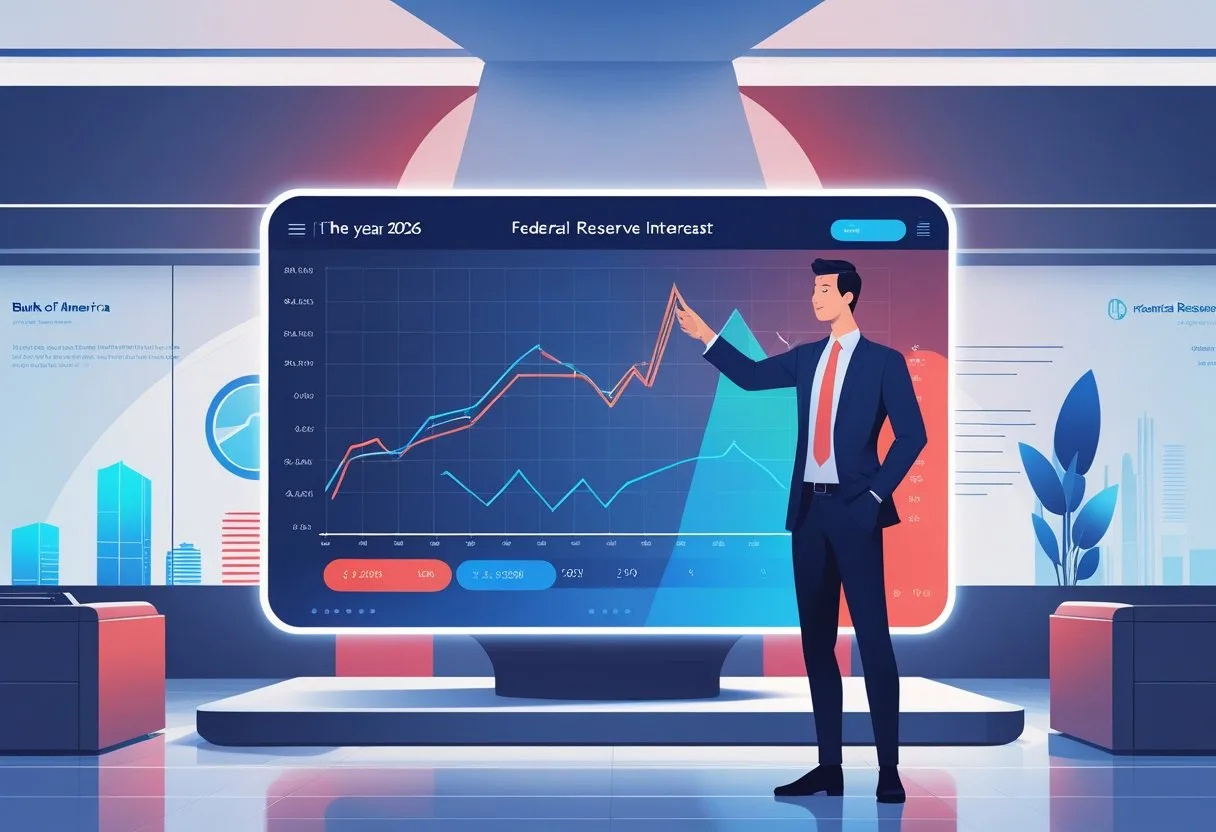
Bank of America expects significant changes in the Federal Reserve’s interest rate policies by 2026. Their outlook focuses on when the Fed might begin cutting rates and what levels those cuts could reach. They base their forecast on inflation trends, economic growth, and the need for stable monetary policy.
Key Projections and Summary
Bank of America predicts that the federal funds rate will drop from around 4.75% today to about 3.50% in early 2026. This represents a more aggressive cut than many other forecasts expect. The expectation is that the Fed will hold rates steady through much of 2025 before beginning reductions, possibly starting as early as September.
They anticipate mortgage rates also falling, with averages near 4.0% in 2026. This suggests a cooling of borrowing costs, which could help support economic growth after a period of tighter monetary policy. The forecast signals a shift focused on balancing inflation control with the need for slower but steady economic expansion.
Factors Influencing the Forecast
Bank of America’s projections are guided by current inflation data, which remains above the Fed’s 2% target but is steadily declining. The CEO Brian Moynihan emphasizes the importance of appropriate monetary policy to avoid a recession while maintaining price stability.
Other economic signals influencing this forecast include slower economic activity in federal districts reported by the Beige Book. The Fed’s caution in raising rates reflects an effort to avoid over-tightening. If inflation continues to fall without sharp economic slowdowns, the Fed will likely begin reducing rates to support growth.
This forecast also considers Bank of America’s view that monetary policy tightening usually takes years to effectively reduce inflation, requiring a steady approach to changes in the fed funds rate. These factors combine to form their surprising but pragmatic outlook for 2026.
For more details, see Bank of America’s interest rate forecast for 2026.
Implications for the U.S. Economy and Markets

The forecasted Fed interest rate moves for 2026 suggest clear trends for economic growth, job markets, inflation, and market behavior. These shifts will shape how businesses, consumers, and investors respond in the coming year.
Economic Growth and Activity
Bank of America’s outlook points to moderate economic growth in 2026. The expectation is that the Fed will maintain steady interest rates to avoid causing a slowdown in economic activity.
Economic growth will likely be slower than in previous years due to cautious business investment and ongoing global uncertainties. However, consumer spending, a key driver of economic activity, should remain stable.
The forecast assumes that fiscal policies and infrastructure spending will support this steady pace. Economic growth will depend heavily on managing trade-offs between keeping inflation low and encouraging enough demand in the economy.
Labor Market Outlook
Employment is expected to remain strong but not overheat. The labor market should continue near full employment levels, as the forecast anticipates no sharp shifts in Fed policy that would disrupt hiring.
Maximum employment is likely sustainable, with gradual job gains mainly in service sectors and technology. Unemployment rates are expected to stay near current lows, reflecting a robust labor market.
However, wage growth may slow slightly as inflationary pressures ease, reducing some cost concerns for employers. This outlook aligns with Bank of America’s view that the Fed’s rate strategy aims to balance growth without increasing unemployment unnecessarily.
Inflation and Consumer Impact
Inflation is forecasted to trend closer to the Fed’s 2% target by the end of 2026. Core personal consumption expenditures (PCE) inflation, the Fed’s favored metric, is expected to gradually decline due to tighter monetary conditions.
Reduced inflationary pressures will help stabilize consumer prices and support purchasing power. Lower inflation means everyday goods and services may see fewer price increases, making it easier for households to manage budgets.
Consumers could benefit from steadier interest rates, avoiding sharp spikes in borrowing costs. This environment should encourage consistent personal consumption, critical to sustaining economic growth.
Market Reactions to the Forecast
Financial markets are expected to respond positively if the Fed’s interest rate moves follow the Bank of America forecast. Steady or slightly lower rates often boost stock valuations by improving borrowing conditions for companies.
Bond markets may see moderate fluctuations as investors adjust to slower inflation and balanced economic signals. Longer-term yields could stabilize as inflation expectations align with the Fed’s goals.
Volatility is likely to remain, driven by geopolitical risks and global economic trends. Yet, the forecast suggests a calmer market compared to periods of aggressive rate hikes.
Key points:
- Fed rate stability supports moderate economic growth
- Labor market stays strong with manageable wage growth
- Inflation trends down, helping consumer spending
- Markets favor steady rates and clear inflation targets
For more detail on the Fed’s past rate cut cycle and its end, see Bank of America’s analysis of the robust job market and rate outlook here.
Federal Reserve’s Role and Statements
The Federal Reserve sets interest rates to influence the economy, balancing inflation and growth. Its decisions rely heavily on data and forecasts. Fed officials share differing views, reflecting on how to handle inflation and economic pressure in the coming years.
Federal Open Market Committee Decisions
The Federal Open Market Committee (FOMC) meets eight times a year to set the federal funds rate, which guides overall interest rates in the U.S. economy. The FOMC targets a specific rate range to control inflation and support employment.
Recently, the committee raised the target range to between 3.75% and 4% for the end of 2025, up from earlier predictions. This action signals a cautious approach to reducing inflation while trying to avoid a recession. The FOMC bases these rate changes on economic data such as inflation rates, job growth, and consumer spending.
Fed Officials’ Perspectives
Fed officials express varied views on the future path of interest rates. Some believe rates should stay high longer to tackle persistent inflation, while others warn that continuing increases could slow economic growth too much.
In 2025 and 2026, officials adjusted forecasts to reflect a median target range closer to 3% to 4%. Their statements suggest a preference for steady or only gradual rate reductions rather than sharp cuts. This cautious stance shows the officials’ intent to keep inflation under control without triggering economic shocks.
Monetary Policy Approaches
The Federal Reserve uses monetary policy tools to influence money supply and demand. By adjusting the fed funds rate, the Fed encourages or discourages borrowing and spending.
The recent approach shows a focus on appropriate monetary policy—neither too loose nor too tight. The Fed aims to balance slowing inflation with maintaining economic stability. This involves careful monitoring and adjusting the rate target based on new economic information to avoid surprises.
For more detail on how Fed officials plan rate moves in 2025 and 2026, see the report on Fed officials’ increased rate forecasts.
Historical and Political Context
The Federal Reserve’s interest rate decisions have shifted significantly in recent years due to economic conditions and political influences. These shifts affect borrowing costs, inflation, and overall economic growth.
Recent Fed Rate Trends
Since 2024, the Federal Reserve has cut the fed funds rate multiple times. This marked a sharp change from the previous years when rates rose steadily to combat inflation. By late 2024, the fed funds rate had dropped to around 4.25% to 4.5%, after reaching higher levels in 2023.
Bank of America’s CEO expects the Fed to hold these rates steady through 2025 and 2026. This outlook reflects a view that inflation pressure will ease slowly, requiring stable rates over several years to ensure economic balance. These moves follow a long history of the Fed adjusting rates cautiously based on inflation data and economic growth.
Impact of Political Events
Political events have influenced Federal Reserve policy indirectly but noticeably. During President Donald Trump’s term, the Fed raised rates multiple times to control early inflation, which was minimal at the time. The administration often criticized these hikes, calling for lower rates to support growth.
More recently, political pressures have shifted toward favoring rate cuts to aid economic recovery amid inflation concerns. Decisions by the Federal Open Market Committee often take these political climates into account, balancing independence with economic stability needs. This makes Fed rate decisions a key focus for both lawmakers and markets.
For further details on rate shifts see the Bank of America CEO’s forecast.
Frequently Asked Questions
Bank of America’s forecast for 2026 expects steady or slightly lower interest rates. This outlook could shape mortgage costs, investor choices, refinancing trends, and returns on savings. It also reflects how the bank analyzes economic signals and impacts consumer credit use.
How will the Bank of America’s interest rate forecast for 2026 affect the mortgage market?
Stable or slightly lower interest rates in 2026 may keep mortgage rates from rising sharply. This can make home loans more affordable for buyers compared to periods of rapid rate increases.
Mortgage lenders might offer more competitive rates, which could encourage more people to apply for home loans.
What strategies should investors consider in light of the forecasted interest rates by Bank of America for 2026?
Investors could focus on bonds and fixed-income assets that benefit from steady or falling rates. They might also consider stocks in sectors sensitive to borrowing costs, such as housing and consumer goods.
Diversifying portfolios to balance income and growth could reduce risks linked to changing rates.
Could Bank of America’s interest rate forecast influence refinancing rates in the coming years?
If rates hold steady or decline as predicted, refinancing existing mortgages may become attractive. Homeowners could lower their monthly payments or shorten loan terms through refinancing.
However, refinancing decisions will depend on individual financial situations and loan conditions.
What implications does the Bank of America’s 2026 interest rate forecast have for savings and CD accounts?
Lower or stable rates could mean that returns on savings accounts and certificates of deposit (CDs) stay relatively low. Savers might see slower growth on these safer investments.
Consumers may look for alternative options to increase earnings on their deposits.
How is the prediction of future interest rates determined by financial institutions like Bank of America?
Banks analyze economic factors such as inflation, employment data, and central bank policies to shape their forecasts. They also assess consumer behavior and global events that affect markets.
This helps them estimate when and how much interest rates may change.
What impact will Bank of America’s interest rate forecast for 2026 have on consumer borrowing and spending?
Stable or slightly lower rates often encourage borrowing by keeping loan costs manageable. This can boost spending on big purchases like homes and cars.
Conversely, it may slow down if consumers expect rates to rise later, leading them to borrow less.