
Artificial intelligence teams face a critical decision when building applications: should they use massive Large Language Models or compact Small Language Models? This choice affects everything from project costs to performance speed, making it one of the most important technical decisions in modern AI development.

The answer depends on your specific needs: choose LLMs for complex reasoning and broad knowledge tasks, but select SLMs for focused applications where speed, cost, and efficiency matter more than versatility. Small Language Models offer simplified architectures with fewer parameters, while LLMs provide massive capabilities at the cost of higher computational requirements.
Understanding when each model type works best can save teams months of development time and thousands of dollars in infrastructure costs. Many developers now suggest using both models together, with SLMs handling simple tasks while LLMs tackle complex problems that require deep reasoning abilities.
Key Takeaways
- SLMs work best for specific tasks where speed and low costs matter more than broad knowledge
- LLMs excel at complex reasoning and general-purpose applications but require significant computational resources
- Combining both model types often provides the best balance of performance and efficiency for enterprise applications
Defining SLMs and LLMs

Small language models and large language models differ primarily in their size, computational requirements, and capabilities. Parameters determine a model’s complexity and ability to understand language patterns.
What Are Small Language Models (SLMs)?
Small language models contain fewer parameters than their larger counterparts. These models typically range from a few million to a few hundred million parameters.
SLMs require less computational power to run. They work well on regular computers and mobile devices. This makes them ideal for businesses with limited resources.
SLMs are designed for specific tasks rather than general-purpose use. They excel in focused applications like technical support or domain-specific chatbots.
The training process for SLMs uses smaller, targeted datasets. This approach helps them learn specific language patterns for particular industries or use cases.
Key characteristics of SLMs:
- Lower memory requirements
- Faster response times
- Cost-effective deployment
- Domain-specific training
What Are Large Language Models (LLMs)?
Large language models contain billions of parameters. Popular examples include GPT-4, GPT-3, and Google’s BERT.
These models require powerful hardware like GPUs or TPUs to operate. They need significant computational resources for both training and running tasks.
LLMs train on massive, diverse datasets from multiple domains. This extensive training allows them to handle complex language tasks across different fields.
The large parameter count enables LLMs to understand context over long text passages. They can maintain conversations and generate detailed, nuanced responses.
Common LLM applications:
- Advanced chatbots
- Content creation
- Scientific research assistance
- Translation services
Understanding Language Model Parameters
Parameters act as the building blocks of language models. They store the knowledge and patterns the model learns during training.
Think of parameters as adjustable settings that help the model make decisions. More parameters generally mean the model can learn more complex patterns and relationships.
Parameter comparison:
- SLMs: 1 million to 500 million parameters
- LLMs: 1 billion to 175+ billion parameters
The number of parameters directly affects computational needs. Models with more parameters need more memory and processing power to function.
Parameters also influence training time and costs. Larger parameter counts require longer training periods and more expensive hardware setups.
Architectures and Technical Foundations
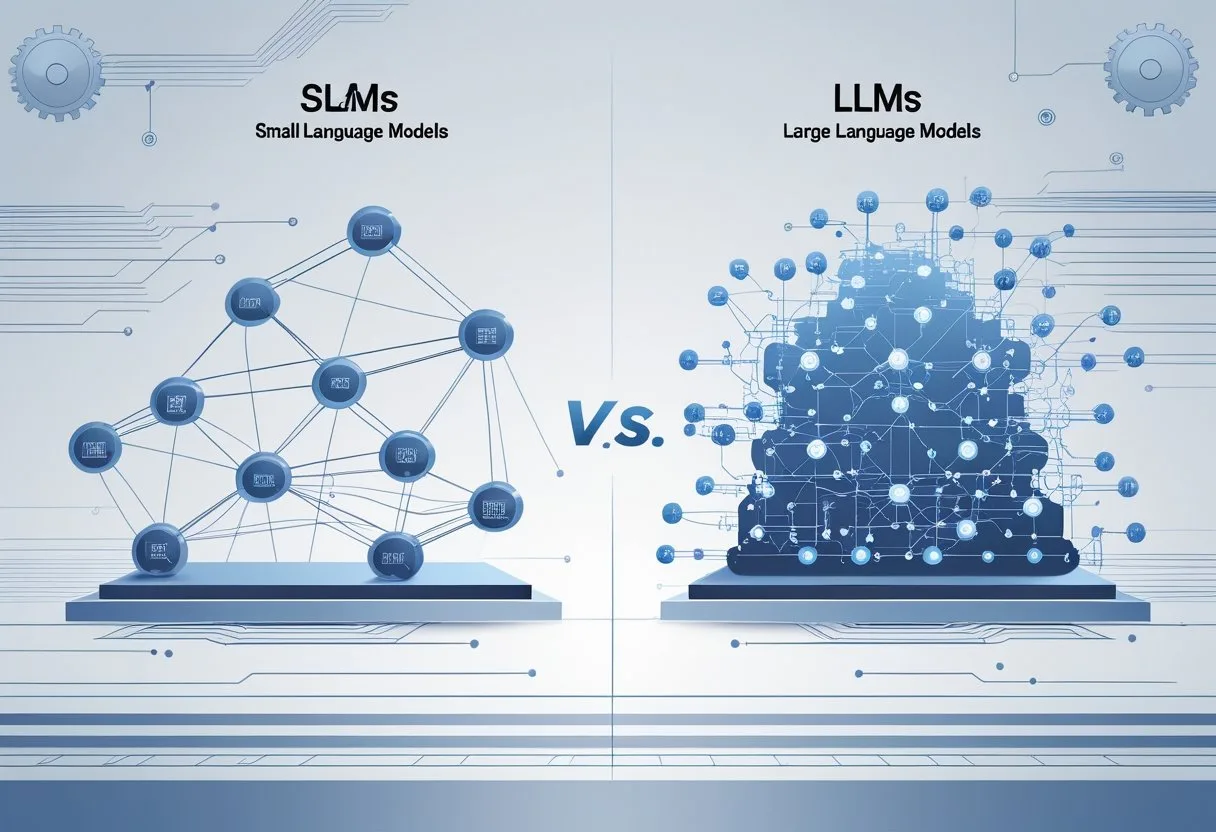
Both SLMs and LLMs share the same core transformer-based architecture but differ in scale and complexity. The transformer architecture uses self-attention mechanisms to process text, while tokenization breaks down language into manageable pieces for the models to understand.
Transformer-Based Architecture Overview
The transformer architecture serves as the foundation for both SLMs and LLMs. This deep learning framework consists of encoder and decoder layers that process sequential data efficiently.
Key Components:
- Encoder layers that analyze input text
- Decoder layers that generate responses
- Feed-forward networks for processing information
- Layer normalization for stable training
LLMs typically contain multiple transformer layers, often ranging from 24 to 96 layers or more. Each layer adds computational complexity and allows the model to capture deeper patterns in language.
SLMs use fewer transformer layers, usually between 6 to 24 layers. This reduction makes them lighter and faster while maintaining basic language understanding capabilities.
The number of parameters directly correlates with the transformer layers. More layers mean more parameters, which increases the model’s ability to understand complex relationships but requires more computational resources.
Self-Attention Mechanism
The self-attention mechanism allows models to focus on relevant parts of input text when processing each word. This process enables understanding of context and relationships between words regardless of their distance in a sentence.
How Self-Attention Works:
- Query, Key, Value matrices are created from input embeddings
- Attention scores are calculated between all word pairs
- Weighted representations are generated based on relevance
- Context-aware embeddings are produced for each position
LLMs use multi-head attention with 12 to 96 attention heads per layer. Each head learns different types of relationships, from syntactic patterns to semantic connections.
SLMs implement fewer attention heads, typically 8 to 16 per layer. This limitation reduces their ability to capture complex relationships but maintains efficiency for simpler tasks.
The self-attention mechanism enables both model types to process text in parallel rather than sequentially. This parallelization significantly improves training and inference speed compared to older architectures.
Tokenization and Embedding Techniques
Tokenization converts raw text into numerical representations that models can process. Modern language models use subword tokenization methods like Byte Pair Encoding (BPE) or SentencePiece.
Common Tokenization Methods:
- Word-level tokenization splits text by spaces and punctuation
- Subword tokenization breaks words into smaller meaningful units
- Character-level tokenization processes individual characters
Both SLMs and LLMs typically use vocabularies of 30,000 to 100,000 tokens. Larger vocabularies help models understand more languages and specialized terminology but increase computational requirements.
Embedding Process:
- Tokens are converted to unique numerical IDs
- Position embeddings indicate word order in sequences
- Token embeddings represent semantic meaning
- Combined embeddings feed into transformer layers
The embedding dimension varies between model sizes. LLMs often use embedding dimensions of 1024 to 12288, while SLMs typically use 256 to 1024 dimensions. Higher dimensions capture more nuanced representations but require more memory and processing power.
Popular Models and Notable Examples
The AI landscape features several standout models in both categories. Small language models like Mistral 7B and DistilBERT offer efficient performance, while large models such as GPT-4 and Claude deliver comprehensive capabilities.
Well-Known SLMs
Mistral 7B stands out as one of the most versatile small language models available today. With 7 billion parameters, it delivers reliable results across various natural language processing tasks.
DistilBERT reduces the original BERT model’s size by 40% while keeping 97% of its performance. It runs faster and uses less memory than full-sized models.
ALBERT uses parameter sharing techniques to create a lighter version of BERT. It achieves better performance on many tasks despite having fewer unique parameters.
TinyBERT compresses BERT even further through knowledge distillation. It maintains strong accuracy while being small enough for mobile devices.
Microsoft’s Phi-4 excels in text generation and mathematical problem-solving. This open-source model works well in educational settings and budget-conscious projects.
Google’s Gemini Nano balances high performance with low resource needs. It’s designed specifically for on-device tasks and mobile applications.
Leading LLMs
GPT-4 remains one of the most powerful language models available. It handles complex reasoning tasks and generates high-quality text across multiple domains.
ChatGPT made AI accessible to millions of users worldwide. Built on GPT technology, it demonstrates conversational abilities and creative problem-solving skills.
Claude 3 from Anthropic emphasizes safety and reliability in AI interactions. It’s designed to minimize harmful or biased outputs in sensitive applications.
LLaMA 3 offers up to 405 billion parameters in its largest version. Meta’s open-source approach allows organizations to customize the model for specific needs.
PaLM from Google showcases strong performance in reasoning and code generation. It demonstrates advanced capabilities in mathematical problem-solving and language understanding.
BLOOM represents a multilingual approach to large language models. It supports dozens of languages and was developed through international collaboration.
Key Differences Between SLMs and LLMs
The main differences between small and large language models center on their size, resource needs, and performance capabilities. SLMs typically have fewer than 100 million parameters while LLMs can exceed 1 trillion parameters, leading to major differences in how they operate and where they work best.
Model Size and Complexity
Parameter Count represents the biggest difference between these models. SLMs contain 10-100 million parameters, while LLMs like GPT-4 use over 1 trillion parameters.
This size gap affects training complexity. LLMs are trained on internet-scale datasets covering books, forums, and articles. SLMs focus on smaller, specialized datasets for specific tasks.
Architecture differences impact deployment options:
- SLMs: Run on CPUs, mobile devices, and edge devices
- LLMs: Require powerful GPU or TPU infrastructure
The smaller architecture makes SLMs easier to fine-tune for specific industries like healthcare or legal services. They need less storage space and transfer less data during operations.
Resource Requirements and Energy Consumption
Computational resources vary dramatically between model types. LLMs generally need powerful GPU infrastructure and large-scale cloud environments.
Deployment costs show major differences:
- SLM deployment: Often under $1,000 per month using CPUs
- LLM deployment: Can exceed $10,000 monthly for heavy usage
Energy consumption favors SLMs significantly. They consume less power during training and inference, making them better for sustainable AI applications and edge AI deployments.
Hardware requirements:
| Model Type | Processing Unit | Memory Needs | Cloud Dependency |
|---|---|---|---|
| SLM | CPU sufficient | Low | Optional |
| LLM | GPU/TPU required | High | Usually needed |
Performance in Real-Time and Complex Reasoning
Real-time applications benefit from SLMs due to their speed advantages. SLMs provide faster responses and lower latency, making them ideal for mobile apps and edge devices.
Complex reasoning tasks favor LLMs. They excel at logical reasoning, handling new tasks with minimal training data, and cross-domain applications requiring broad knowledge.
Performance trade-offs:
- SLMs: Excel at specific tasks, instant responses, battery efficiency
- LLMs: Superior at general tasks, natural language fluency, versatile problem-solving
Large-scale AI applications often use LLMs for their versatility. However, SLMs work better for specialized fields where accuracy in specific domains matters more than general knowledge.
Response time differences become critical in real-time applications where milliseconds matter for user experience.
Use Cases and Applications
Both SLMs and LLMs excel in different scenarios based on their design and capabilities. SLMs deliver targeted performance for specific tasks like text classification, while LLMs handle complex reasoning and broad knowledge requirements.
Text Classification and Sentiment Analysis
SLMs dominate text classification tasks due to their focused training and efficient processing. They excel at categorizing emails, sorting customer feedback, and detecting spam with high accuracy.
For sentiment analysis, SLMs process social media posts and product reviews quickly. Their smaller size allows real-time analysis of thousands of messages without significant computational overhead.
Popular SLM applications include:
- Email filtering and spam detection
- Social media monitoring
- Product review categorization
- News article classification
LLMs can handle text classification but often provide unnecessary complexity. They work better when classification requires deep contextual understanding or multiple languages simultaneously.
Domain-specific customization makes SLMs ideal for specialized classification tasks in healthcare, finance, or legal industries where accuracy matters most.
Chatbots and Virtual Assistants
LLMs power sophisticated chatbots that handle diverse conversations and complex queries. They understand context across long conversations and provide detailed, nuanced responses.
SLMs work well for focused chatbot applications. They handle specific customer service tasks, product support, or FAQ responses efficiently on mobile devices.
Deployment considerations:
| Model Type | Best For | Key Advantage |
|---|---|---|
| SLMs | Task-specific bots | Fast response times |
| LLMs | General-purpose assistants | Broad knowledge base |
Virtual assistants on mobile devices benefit from SLMs because they run locally without internet connectivity. This reduces latency and protects user privacy.
LLMs excel when virtual assistants need to handle unexpected questions or provide creative solutions. They adapt to new topics without additional training.
Question Answering and Language Understanding
LLMs demonstrate superior question answering capabilities across diverse topics. They process complex multi-part questions and provide comprehensive answers with proper context.
Their training on vast datasets enables understanding of subtle language nuances. LLMs handle ambiguous questions and provide clarifying follow-up responses.
SLMs perform well in specialized domains where questions follow predictable patterns. Medical Q&A systems or technical support applications benefit from their focused expertise.
Language understanding varies significantly between model types:
- SLMs: Excel at domain-specific terminology and patterns
- LLMs: Handle multiple languages and cultural contexts
- Both: Process natural language inputs effectively
SLMs deliver greater accuracy in domain-specific tasks when properly fine-tuned on relevant datasets. This makes them valuable for specialized question answering systems.
Domain-Specific Implementations
Healthcare applications favor SLMs for processing medical records, analyzing patient data, and supporting clinical decisions. Their focused training ensures compliance with medical terminology and regulations.
Financial institutions deploy SLMs for fraud detection, risk assessment, and regulatory reporting. These models understand industry-specific language and maintain data privacy requirements.
Key implementation advantages:
- Faster deployment on edge devices
- Lower operational costs for specific tasks
- Enhanced privacy through local processing
- Regulatory compliance in sensitive industries
LLMs work better for cross-domain applications requiring broad knowledge. Legal firms use LLM-powered assistants to scan and summarize complex case documents across different practice areas.
Manufacturing and logistics benefit from SLMs trained on operational data. These models optimize supply chains, predict equipment failures, and improve quality control processes.
AI deployment strategies depend on specific industry needs and technical constraints rather than model size alone.
Choosing Between SLMs and LLMs
The decision requires careful analysis of specific technical requirements, resource constraints, and business objectives. Organizations must evaluate performance needs, security requirements, and customization capabilities to make the right choice.
Evaluation Criteria for Selection
Task complexity serves as the primary factor in choosing between SLMs and LLMs. SLMs work best for focused tasks like sentiment analysis or simple classification.
LLMs excel at complex reasoning, multi-step problem solving, and tasks requiring broad knowledge. They handle ambiguous queries and provide more natural conversational responses.
Resource availability determines feasibility. SLMs need less computational power and can run on smaller hardware setups. LLMs require substantial processing power and memory resources.
Performance expectations matter significantly. LLMs typically deliver higher accuracy across diverse tasks. SLMs retain strong performance only when tasks align closely with their training benchmarks.
Integration complexity affects timeline and costs. SLMs can create hidden challenges requiring prompt adjustments and additional debugging time.
Cost, Data Security, and Privacy Considerations
Operational costs vary dramatically between model types. SLMs consume less energy and require smaller infrastructure investments. They offer predictable hosting expenses and lower ongoing maintenance costs.
LLMs demand significant computational resources but often provide better cost-per-task efficiency for complex work. Cloud-based LLM services charge per token or request.
Data security becomes critical when handling sensitive information. Private LLMs allow organizations to maintain complete control over proprietary data.
SLMs can run entirely on-premises, eliminating data transmission risks. This approach suits organizations with strict compliance requirements or confidential datasets.
Privacy regulations influence model selection. Industries like healthcare and finance often require data processing within controlled environments. Local SLM deployment ensures compliance with regional data protection laws.
Fine-Tuning and Customization
Fine-tuning approaches differ significantly between model types. SLMs require less data and computational power for domain-specific training. Organizations can customize them with smaller datasets and limited resources.
LLMs offer more sophisticated fine-tuning capabilities but demand substantial training data. They can learn complex patterns and adapt to specialized vocabularies more effectively.
Domain specialization presents interesting trade-offs. Domain-specific models don’t always outperform general LLMs, even in specialized fields like finance.
Customization flexibility varies by model architecture. SLMs allow easier modification of specific behaviors and responses. They enable rapid prototyping and iterative improvements.
LLMs provide deeper customization through advanced training techniques. They support complex prompt engineering and can maintain consistency across diverse tasks while incorporating domain knowledge.
Frequently Asked Questions
Small language models typically use 1-7 billion parameters while large language models contain 70 billion or more parameters. Fine-tuning significantly improves task-specific performance for both model types, with SLMs showing greater efficiency gains in specialized domains.
What are the key differences between SLMs and LLMs in language model performance?
SLMs contain fewer parameters, typically ranging from 1 to 7 billion, while LLMs use 70 billion parameters or more. This difference directly impacts their performance across various tasks.
Large language models demonstrate superior capabilities in complex problem-solving, content generation, and reasoning tasks. They provide more detailed explanations and handle nuanced language challenges better.
SLMs excel in specific areas like language translation and simple dialogue tasks. They process information faster due to their smaller size but may struggle with complex mathematical problems.
The performance gap becomes most apparent in tasks requiring deep reasoning or extensive knowledge synthesis. LLMs consistently outperform SLMs in mathematical problem-solving and comprehensive analysis.
How does fine-tuning affect the capabilities of generative AI models?
Fine-tuning allows both SLMs and LLMs to specialize in specific domains or tasks. This process involves training the model on targeted datasets relevant to particular use cases.
Domain-specific fine-tuning can help SLMs outperform larger generalist models when working with specialized business tasks. The focused training improves accuracy and relevance for specific applications.
Fine-tuned SLMs require less computational power and training time compared to fine-tuned LLMs. This makes them more accessible for organizations with limited resources.
The fine-tuning process can significantly improve task performance for both model types. However, the baseline capabilities of the original model still influence the final results.
In what scenarios is a SLM preferable over an LLM for language processing tasks?
SLMs work best in resource-constrained environments like smartphones and embedded devices. They provide efficient solutions when computational power is limited.
Organizations benefit from SLMs when they need faster processing times and lower operational costs. These models require less maintenance and infrastructure investment.
SLMs excel in focused, domain-specific applications where specialized knowledge matters more than broad capabilities. They perform well in customer service chatbots and simple content generation tasks.
Companies with limited budgets or specific use cases find SLMs more practical. They offer sufficient performance for many business applications without the complexity of larger models.
What are the considerations for choosing between a small and large language model based on model parameters?
Parameter count directly affects model capabilities and resource requirements. More parameters generally mean better performance but higher computational costs.
LLMs with billions of parameters require significant infrastructure and maintenance resources. Organizations must consider their technical capacity before implementation.
SLMs with fewer parameters offer faster inference times and lower energy consumption. They work well for applications where speed matters more than complex reasoning.
The choice depends on balancing performance needs with available resources. Organizations should evaluate their specific requirements against the costs of each model type.
Can you provide a comparison of SLMs and LLMs in terms of computational efficiency and resource usage?
SLMs demonstrate significantly better operational efficiency with faster training times and quicker task execution. They consume less energy and require smaller hardware setups.
LLMs demand substantial computational resources for both training and inference. They need powerful GPUs and extensive memory to operate effectively.
SLMs can run on standard hardware configurations, making them accessible to smaller organizations. They process queries more rapidly with reduced response latency.
The maintenance requirements differ dramatically between the two model types. SLMs need minimal ongoing support while LLMs require dedicated technical teams and infrastructure management.
What are some notable examples of small language models currently in use and their applications?
Meta’s Llama 3.2-1B offers multilingual capabilities optimized for dialogue and summarization tasks. It works well in conversational applications and content processing.
Google’s Gemma 2.2B delivers impressive performance with only 2.2 billion parameters. This model demonstrates efficient language processing in compact applications.
These SLMs find applications in mobile apps, embedded systems, and edge computing devices. They power chatbots, language translation tools, and simple content generation systems.
Companies use these models for customer support automation and basic text analysis tasks. Their efficiency makes them suitable for real-time applications where quick responses are essential.