

Proteins are the building blocks of life, but predicting how they fold into complex 3D shapes has puzzled scientists for decades. This challenge, known as the protein folding problem, required years of expensive experiments to solve for each individual protein. AlphaFold is an AI system developed by Google DeepMind that can accurately predict a protein’s 3D structure from its amino acid sequence, revolutionizing biology and earning recognition through the 2024 Nobel Prize in Chemistry.
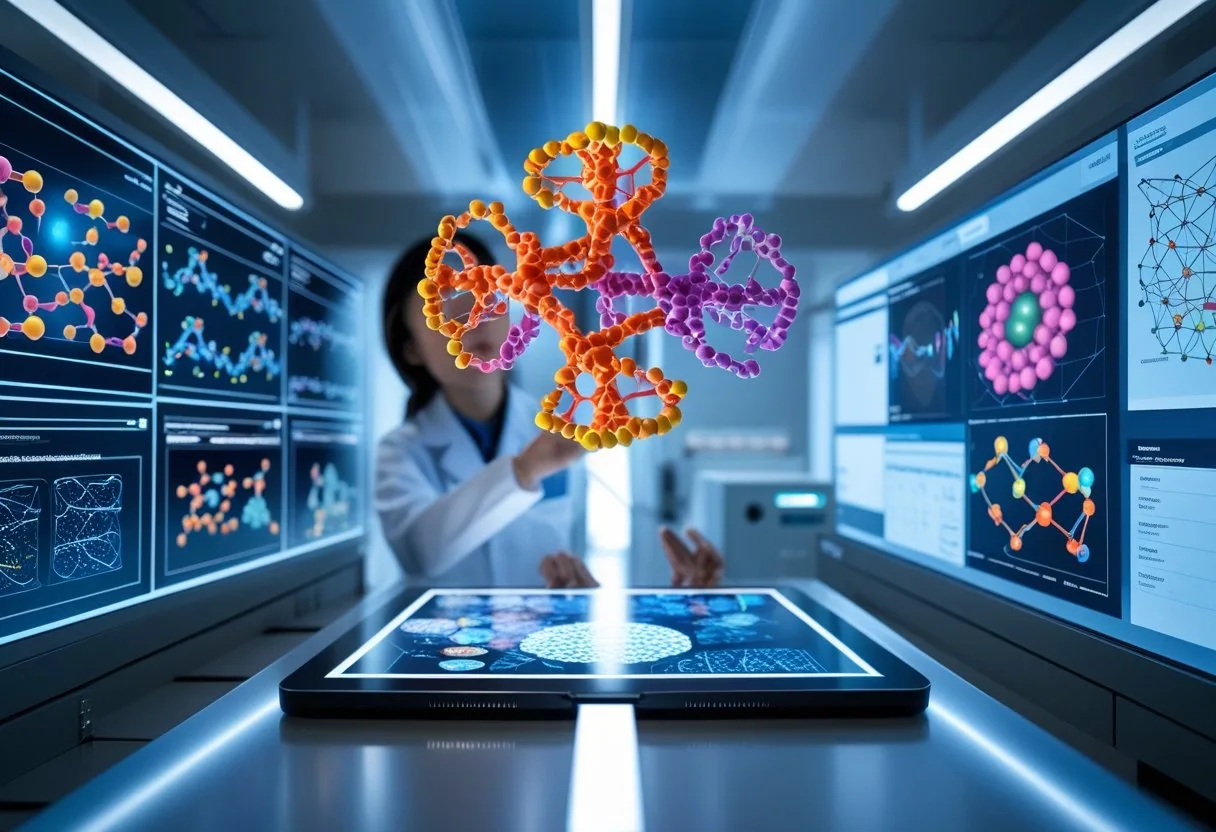
AlphaFold stunned the scientific community in 2020 by achieving accuracy levels that rival traditional experimental methods. The system has since revealed millions of protein structures and made this information freely available to researchers worldwide. Over two million researchers from 190 countries have used the AlphaFold database to advance their work.
This breakthrough represents more than just a technological achievement. AlphaFold allows scientists to skip years of trial-and-error experiments, accelerating drug discovery, disease research, and molecular design. The system has opened new doors in fields ranging from medicine to climate science, showing how AI can transform scientific discovery.
Key Takeaways
- AlphaFold solves the decades-old protein folding problem by predicting 3D protein structures from amino acid sequences with experimental-level accuracy
- The system has made millions of protein structures freely available to over two million researchers worldwide, democratizing access to critical biological data
- AlphaFold accelerates scientific research by eliminating years of expensive experiments, enabling faster drug discovery and breakthroughs across multiple fields
The Protein Folding Problem
For over 50 years, scientists struggled to predict how proteins fold into their final shapes from just their amino acid sequences. This challenge blocked progress in drug discovery, disease research, and understanding basic life processes.
Why Protein Structure Matters
Proteins control nearly every biological function in living cells. They act as enzymes that speed up chemical reactions. They transport molecules throughout the body. They defend against infections and diseases.
A protein’s shape determines what job it can do. If the shape changes, the protein may stop working properly. This can lead to serious diseases.
Many major health problems stem from misfolded proteins. Alzheimer’s disease occurs when brain proteins clump together abnormally. Cystic fibrosis results from a single protein folding incorrectly. Cancer can develop when proteins that control cell growth lose their proper structure.
Scientists need to know protein shapes to design new medicines. Drugs work by fitting into specific spots on protein surfaces, like keys fitting into locks. Without knowing the protein’s exact shape, researchers cannot create effective treatments.
Challenges in Experimental Protein Structure Determination
Traditional methods for finding protein structures require expensive equipment and take years of work. X-ray crystallography forces proteins to form crystals, then shoots X-rays through them to reveal their structure. This process often fails because many proteins refuse to crystallize.
Nuclear magnetic resonance spectroscopy studies proteins in solution but works only on small proteins. The equipment costs millions of dollars and requires highly trained specialists.
Scientists have mapped only about 170,000 protein structures using these methods. Yet databases contain over 180 million known protein sequences. This massive gap between known sequences and known structures highlighted the need for efficient computational solutions.
Each experimental structure determination can take months or years. Researchers must purify the protein, grow crystals or prepare samples, collect data, and solve the structure through complex calculations.
Amino Acids and Protein Folding
Proteins are chains of building blocks called amino acids. Twenty different amino acids exist in nature. Each has unique chemical properties that affect how the protein folds.
The sequence of amino acids determines the final protein shape. In 1972, Nobel Prize winner Christian Anfinsen proposed that a protein’s amino acid sequence should fully determine its structure.
The number of possible protein shapes is enormous. A typical protein could theoretically fold into 10^300 different shapes. Checking each possibility would take longer than the age of the universe.
Yet proteins in living cells fold correctly within milliseconds. This puzzle became known as Levinthal’s paradox – how do proteins find their correct shape so quickly when so many options exist?
The folding process involves complex interactions between amino acids. Some amino acids attract water molecules. Others repel water and stick together. These forces guide the protein chain into its final three-dimensional structure.
AlphaFold: The Game-Changing AI Solution

AlphaFold represents an AI system that solved the 50-year-old protein folding problem by predicting 3D protein structures from amino acid sequences. The breakthrough combines deep learning algorithms with massive protein databases to achieve unprecedented accuracy in structural biology.
Origins and Development by DeepMind
DeepMind created AlphaFold as part of their mission to solve intelligence and advance scientific discovery. The London-based AI company, founded by Demis Hassabis, began working on the protein folding problem in 2016.
John Jumper led the AlphaFold project at DeepMind. He assembled a team of machine learning experts and structural biologists to tackle this grand challenge in biology.
The team released AlphaFold 1 in 2018, which showed promise but limited accuracy. They then developed AlphaFold 2, which achieved remarkable precision in 2020.
AlphaFold 2 won recognition through a Nobel Prize for its revolutionary impact on chemistry and biology. The system marked a turning point where artificial intelligence could solve fundamental scientific problems.
DeepMind made the technology freely available to researchers worldwide. This open approach accelerated scientific research across multiple fields.
How AlphaFold Predicts Protein Structures
AlphaFold uses machine learning to predict protein structures by analyzing amino acid sequences and evolutionary patterns. The AI system examines how proteins evolved over millions of years to understand folding rules.
The neural network processes several key inputs:
- Amino acid sequences – The primary structure of target proteins
- Multiple sequence alignments – Related protein sequences from evolution
- Template structures – Known protein shapes with similar sequences
- Evolutionary couplings – Amino acid pairs that co-evolve together
AlphaFold analyzes evolutionary history and protein similarities to make accurate predictions. The system identifies which amino acids interact with each other in the folded protein.
The AI outputs confidence scores for each prediction. High confidence regions typically match experimental structures with near-perfect accuracy.
This process reduces research time from years to minutes compared to traditional experimental methods.
Role of Data and Deep Learning in AlphaFold
Deep learning forms the core of AlphaFold’s success through advanced neural network architectures. The system uses attention mechanisms to identify important relationships between distant amino acids in protein sequences.
AlphaFold trains on massive datasets containing:
| Data Type | Purpose |
|---|---|
| Protein sequences | Learn evolutionary patterns |
| Known structures | Understand folding principles |
| Genomic data | Find related protein families |
| Chemical properties | Predict amino acid interactions |
The AI system processes vast datasets to learn general principles of protein folding. Training data includes millions of protein sequences and hundreds of thousands of known structures.
Deep learning allows AlphaFold to recognize complex patterns that humans cannot detect. The neural networks identify subtle correlations between sequence and structure across different protein families.
AlphaFold now provides access to over 200 million protein predictions through its public database. This data accelerates research in drug discovery, disease understanding, and biotechnology applications.
Key Achievements and Recognitions
AlphaFold achieved unprecedented accuracy in protein structure prediction and earned the Nobel Prize in Chemistry for its creators. The AI system has made over 200 million protein structures freely available to researchers worldwide.
Atomic Accuracy and CASP Competitions
AlphaFold dominated the Critical Assessment of Structure Prediction (CASP) competitions. These contests challenge scientists to predict protein structures from amino acid sequences.
In CASP14 in 2020, AlphaFold achieved median accuracy scores above 90. This performance matched experimental methods like X-ray crystallography for many proteins.
The system solved structures that had puzzled scientists for decades. It predicted complex protein folds with atomic-level precision in most cases.
CASP judges called AlphaFold’s performance a major breakthrough. The AI system outperformed all other computational methods by huge margins.
Nobel Prize in Chemistry for AlphaFold
The 2024 Nobel Prize in Chemistry went to Demis Hassabis and John Jumper from DeepMind, along with David Baker from the University of Washington.
The Nobel Committee recognized their work on protein structure prediction and design. They called AlphaFold a breakthrough that solved a 50-year-old problem in biology.
This marked the first time AI researchers won the Nobel Prize in Chemistry. The recognition highlighted how artificial intelligence now drives major scientific discoveries.
Each Nobel Prize is worth 11 million Swedish kronor (US$1 million). Baker received half the prize money, while Hassabis and Jumper split the other half.
Open Source AlphaFold Database
DeepMind created the AlphaFold Protein Structure Database to share their predictions freely. The database contains over 200 million protein structures from various organisms.
Scientists from 190 countries use this resource. More than two million researchers have accessed the database since its launch.
The database covers proteins from humans, plants, bacteria, and other life forms. Each structure includes confidence scores showing how reliable the predictions are.
This open approach accelerated research in drug discovery and biology. Researchers can now study proteins that were impossible to analyze before AlphaFold.
Transformative Impact on Science and Research
AlphaFold has revolutionized how scientists approach biological research by solving the 50-year protein folding problem and providing accurate protein structure predictions for nearly 200 million proteins. The AI system has compressed decades of traditional lab research into days or hours, fundamentally changing drug development, pathogen analysis, and personalized treatment approaches.
Accelerating Biological Discoveries
AlphaFold has transformed biological research by eliminating years of experimental work traditionally required to determine protein structures. Scientists previously spent months or years using expensive techniques like X-ray crystallography and nuclear magnetic resonance spectroscopy.
The system achieves a median accuracy score of 92.4 GDT, which means predictions have an average error of approximately 1.6 angstroms. This level of precision is comparable to experimental methods.
Key Research Accelerations:
- Membrane proteins: Difficult to crystallize structures now predicted computationally
- Unknown protein functions: Analysis of 180 million protein sequences versus only 170,000 known structures
- Evolutionary studies: Better understanding of protein relationships across species
Over 2.5 million researchers worldwide have adopted AlphaFold for their studies. One research team solved a protein structure they were stuck on for nearly a decade using AlphaFold’s predictions.
Enabling Drug Discovery
Drug discovery relies heavily on understanding protein structures since most medications work by binding to specific proteins. AlphaFold provides researchers with accurate structural models of potential drug targets without lengthy experimental determination.
The system significantly reduces research costs and time associated with complex experimental procedures. Pharmaceutical companies can now identify promising drug candidates faster by analyzing how potential medications might interact with target proteins.
Drug Development Benefits:
- Target identification: Rapid analysis of disease-related proteins
- Lead optimization: Better understanding of drug-protein interactions
- Side effect prediction: Analysis of off-target protein binding
Scientists can focus their experimental efforts on the most promising compounds rather than spending years determining basic protein structures. This approach allows for more precise drug design and potentially safer medications.
Understanding Pathogens
AlphaFold has proven valuable for analyzing disease-causing organisms by predicting structures of pathogen proteins. During the COVID-19 pandemic, researchers predicted several SARS-CoV-2 virus protein structures, including ORF3a and ORF8.
These predictions help scientists understand how pathogens function and identify potential therapeutic targets. Researchers achieved high accuracy on coronavirus protein predictions despite their challenging nature and limited related sequence data.
Pathogen Research Applications:
- Viral protein analysis: Understanding infection mechanisms
- Bacterial resistance: Analyzing antibiotic-resistant protein variants
- Vaccine development: Identifying immunogenic protein regions
The rapid structural predictions enable faster response to emerging infectious diseases. Scientists can analyze pathogen proteins within days rather than months, supporting quicker development of treatments and preventive measures.
Personalized Medicine Advancements
Protein structure prediction contributes to personalized medicine by helping researchers understand how genetic variations affect protein function. Different individuals may have protein variants that respond differently to medications or disease processes.
AlphaFold enables analysis of how mutations change protein structures and potentially alter their biological activity. This information supports development of targeted therapies based on individual genetic profiles.
Personalized Treatment Areas:
- Genetic disorders: Understanding disease-causing protein mutations
- Cancer therapy: Analyzing tumor-specific protein variants
- Pharmacogenomics: Predicting individual drug responses
Researchers can now examine how specific genetic variants might affect protein folding and function. This capability advances precision medicine approaches that tailor treatments to individual patients based on their unique molecular profiles.
The technology helps identify patients who might benefit most from specific therapies while avoiding treatments likely to be ineffective or cause adverse reactions.
Beyond Proteins: AlphaFold’s Expanding Capabilities
AlphaFold’s latest model can now generate predictions for nearly all molecules in the Protein Data Bank, including DNA, RNA, and small molecule ligands. This expansion transforms the AI system from a protein-focused tool into a comprehensive platform for understanding biological interactions across ecosystems.
Modeling DNA, RNA, and Other Biomolecules
The newest version of AlphaFold predicts structures for multiple types of biomolecules beyond proteins. It accurately models DNA, RNA, and ligands (small molecules) together in complex biological systems.
The AI can now predict protein-ligand structures without requiring reference protein structures. This capability surpasses traditional docking methods used in drug discovery.
Key biomolecule types AlphaFold now handles:
- DNA sequences and their 3D structures
- RNA molecules and their folding patterns
- Small molecule ligands that bind to proteins
- Post-translational modifications (PTMs)
AlphaFold 3 takes us beyond proteins to a broad spectrum of biomolecules. The system models how these different molecules interact with each other in living cells.
One example involves CasLambda bound to crRNA and DNA. This complex is part of the CRISPR family used for gene editing. AlphaFold can predict how all three components work together.
Ecosystem and Environmental Science Applications
Environmental science applications remain limited in current AlphaFold implementations. The system primarily focuses on individual biomolecules rather than ecosystem-level interactions.
Researchers have used AlphaFold data to study plastic-eating enzymes. These enzymes could help tackle environmental pollution by breaking down waste materials.
Potential environmental applications include:
- Studying plant immunity mechanisms
- Understanding biorenewable materials
- Analyzing enzyme functions in soil bacteria
- Modeling protein interactions in marine organisms
The AI provides insights into disease pathways that affect wildlife populations. It helps researchers understand how environmental factors influence protein structures in different species.
AlphaFold has already catalyzed major scientific advances around the world. However, most environmental applications remain in early research phases rather than practical implementation.
Limitations, Challenges, and the Future of AlphaFold
AlphaFold faces significant challenges despite its groundbreaking success in protein structure prediction. Researchers have uncovered weaknesses in AlphaFold 3 that highlight the ongoing need for improvement in artificial intelligence models.
Biases and Limitations in AI Training Data
The artificial intelligence behind AlphaFold shows clear limitations when tested against real-world scenarios. High schoolers revealed AI’s flaws in bioinformatics challenges by testing the system’s ability to predict how mutations impact protein stability.
Researchers at Skoltech found that AlphaFold’s predictions often contradicted experimental results. This challenges claims that the deep learning model has mastered predicting protein physics.
Key Training Data Issues:
- Limited diversity in protein structures used for training
- Bias toward well-studied proteins from specific organisms
- Gaps in understanding how proteins behave in different conditions
- Difficulty predicting protein interactions with other molecules
The ai system excels at single protein chains but struggles with complex interactions. AlphaFold2 required a separate extension called AlphaFold-Multimer to predict protein-protein complexes.
Unsolved Problems and Next Frontiers
Despite remarkable progress, the AlphaFold series faces persistent challenges in its development. Scientists continue working on problems that current models cannot solve effectively.
Major Unsolved Areas:
- Predicting how proteins change shape over time
- Understanding protein behavior in living cells versus isolated conditions
- Modeling protein interactions with drugs and other small molecules accurately
- Accounting for environmental factors that affect protein structure
The data used to train these systems comes primarily from laboratory studies. Real biological systems are far more complex than controlled laboratory conditions.
Future versions must address these gaps to become truly useful for drug discovery and medical research. AlphaFold 3 showcases the potential of deep learning while underscoring the importance of transparency in developing these powerful tools.
The Role of Human Creativity in AI Research
Human scientists remain essential for interpreting and improving artificial intelligence predictions. The most successful applications of AlphaFold combine ai capabilities with human expertise and creativity.
Researchers must validate ai predictions through experiments and real-world testing. They also design new approaches to overcome current limitations in the technology.
Human Contributions Include:
- Designing better training methods for deep learning models
- Creating new ways to test and validate ai predictions
- Identifying which problems are most important to solve
- Combining ai results with other scientific knowledge
Scientists continue developing hybrid approaches that use both artificial intelligence and traditional research methods. This combination often produces better results than either approach alone.
The future success of AlphaFold depends on continued collaboration between human researchers and ai systems. Each brings unique strengths that complement the other’s limitations.
Human creativity drives the questions that need answering. Artificial intelligence provides powerful tools to find those answers more quickly and accurately than ever before.
Frequently Asked Questions
AlphaFold represents a major breakthrough in computational biology, solving the protein folding problem that puzzled scientists for over 50 years. The AI system transforms protein structure prediction from a years-long process into one that takes minutes.
What is the significance of AlphaFold in the field of protein folding?
AlphaFold solved the protein folding problem, which had challenged scientists for more than five decades. Before this breakthrough, determining a single protein structure could take several years and cost hundreds of thousands of dollars.
The AI system can predict protein structures in minutes with remarkable accuracy. This represents a fundamental shift in how researchers approach protein research.
AlphaFold has revealed millions of intricate 3D protein structures. Scientists can now understand how life’s molecules interact without spending years on trial-and-error experiments.
The breakthrough allows researchers to redirect valuable time and resources toward advancing medical and environmental research. This paradigm shift promises to unlock vast new possibilities in experimental science.
How does AlphaFold differ from previous approaches to predicting protein structures?
Traditional methods for determining protein structures relied on experimental techniques like X-ray crystallography and nuclear magnetic resonance. These approaches required physical samples and extensive laboratory work.
AlphaFold predicts biological molecules’ 3D structures from just their amino acid sequences. The AI system uses computational methods instead of physical experiments.
Previous computational approaches struggled with accuracy and took much longer to produce results. AlphaFold combines deep learning with advanced algorithms to achieve unprecedented precision.
The system processes amino acid sequences and generates detailed 3D structural predictions. This eliminates the need for costly and time-consuming laboratory procedures in many cases.
What are the potential implications of AlphaFold on drug discovery and biomedical research?
AlphaFold allows researchers to focus their efforts on designing new proteins, understanding disease, and accelerating drug discovery. Scientists can identify drug targets more quickly and efficiently.
Understanding protein structures helps researchers develop medications that interact with specific molecular targets. This knowledge speeds up the drug development process significantly.
The system enables scientists to study disease-related proteins without lengthy experimental procedures. Researchers can investigate how mutations affect protein function and contribute to various conditions.
AlphaFold helps scientists understand what individual proteins do and how they interact with other molecules. This knowledge supports the development of more targeted therapies.
Can AlphaFold’s predictions be considered as accurate as experimental methods like X-ray crystallography?
AlphaFold can predict protein structures with unprecedented accuracy. The system achieves results comparable to experimental methods in many cases.
However, experimental techniques like X-ray crystallography still provide the gold standard for protein structure determination. AlphaFold predictions work best when combined with experimental validation.
The AI system performs exceptionally well for proteins with known structural patterns. It may be less reliable for completely novel protein folds or unusual structures.
Scientists often use AlphaFold predictions as starting points for experimental research. The combination of computational predictions and laboratory validation produces the most reliable results.
How does AlphaFold utilize artificial intelligence and machine learning to predict protein structures?
AlphaFold is an artificial intelligence system that uses deep learning to solve the protein folding problem. The system analyzes amino acid sequences to predict 3D structures.
The AI was trained on vast databases of known protein structures and sequences. It learned patterns between amino acid sequences and their corresponding folded shapes.
AlphaFold 3 can predict the 3D structures of proteins and other biomolecules like DNA, RNA, and small molecules. The latest version expands beyond proteins to other biological molecules.
The system uses neural networks to process sequence information and generate structural predictions. Multiple computational layers work together to refine and improve accuracy.
What challenges does AlphaFold address in the understanding of biological processes?
Proteins underpin every biological process in every living thing. Understanding their structures is essential for comprehending how life functions at the molecular level.
Before AlphaFold, the time and cost required for protein structure determination limited research progress. Many important proteins remained unstudied due to these barriers.
The system addresses the challenge of understanding protein interactions in complex biological systems. Scientists can now study how multiple proteins work together in cellular processes.
AlphaFold helps researchers tackle society’s biggest medical and environmental challenges by providing structural insights into key biological molecules. This knowledge supports research into diseases, environmental problems, and biotechnology applications.